Raw Feeding Puppies UK: Beginner's Guide
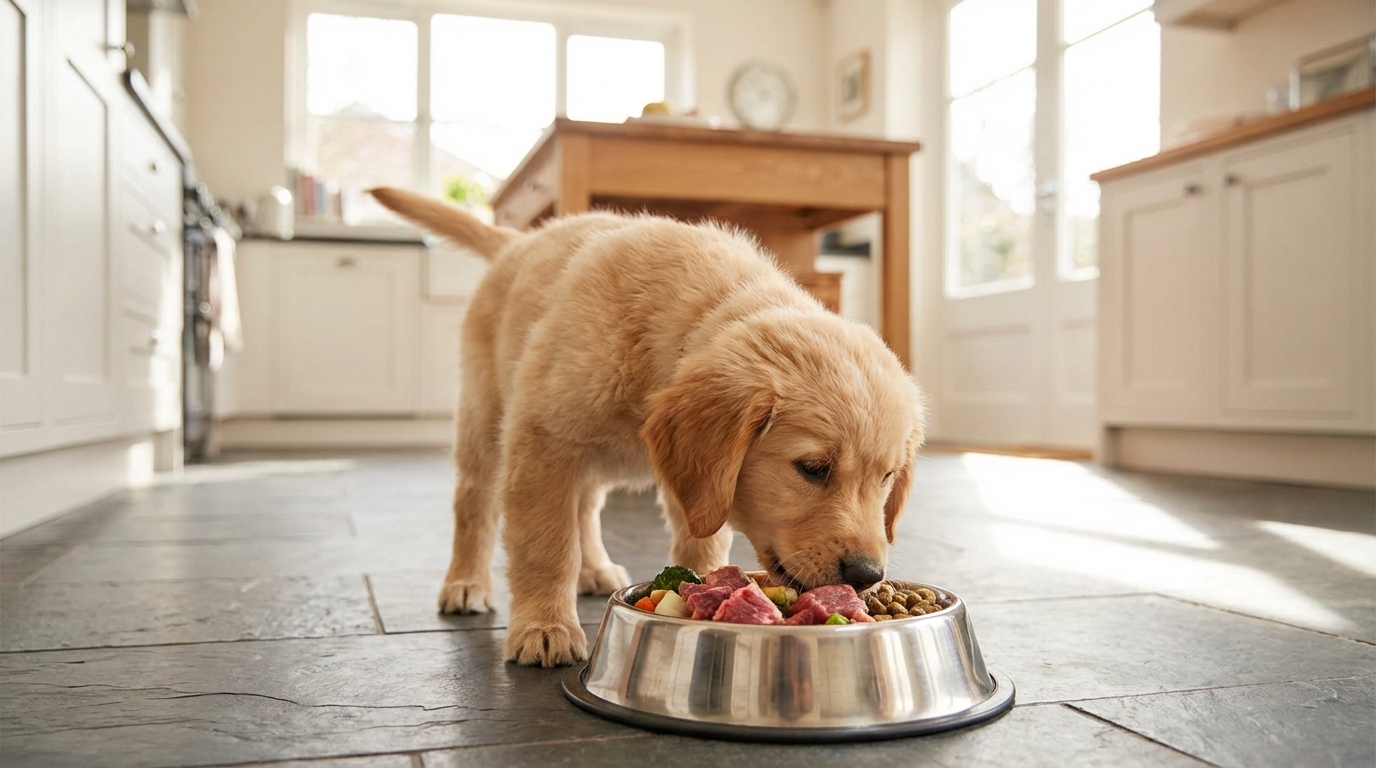
Raw feeding puppies is one of the best decisions you can make for their long-term health and development. Done correctly, puppies fed raw diets from a young age tend to have stronger immune systems, better dental health, clearer skin, and more stable energy levels than their kibble-fed counterparts. But puppy raw feeding does require attention to detail—growth is rapid, nutritional needs are higher, and the margins for error are smaller. This comprehensive guide walks you through everything you need to know. For detailed ratio guidance, see our comprehensive portion guide.
When Can Puppies Start Eating Raw Food?
The timing depends on your pup's situation:
Puppies Still with Mother (3-4 Weeks)
You can introduce small amounts of raw food from about 3-4 weeks whilst puppies are still nursing. At this stage, mum is still providing crucial antibodies and nutrition through milk, but puppies are increasingly interested in solid food. Introduce minced raw meat in tiny portions (a tablespoon at a time) alongside nursing.
Newly Weaned Puppies (6-8 Weeks)
Most puppies are fully weaned and ready for raw feeding around 8 weeks old. If you're bringing home a new puppy at 8-12 weeks, this is the ideal time to establish raw feeding. Even if they've had kibble or wet food from their breeder, switching to raw is straightforward at this age.
If you're adopting or acquiring a puppy that's already older (12+ weeks), they can transition to raw without difficulty, though you may want to do it gradually over 7-10 days to avoid digestive upset. Learn more from The Kennel Club's puppy guidance.
The Sliding Scale: How Much to Feed by Age
Puppy feeding is dramatically different from adult feeding. Puppies are growing rapidly and have much higher caloric and nutritional demands. This is where the "sliding scale" comes in—the percentage of body weight needed decreases as your puppy grows.
Puppy Feeding Percentages by Age
- 8-12 weeks: 8% of body weight daily (4 meals)
- 3-4 months: 6% of body weight daily (3 meals)
- 4-6 months: 5-6% of body weight daily (3 meals)
- 6-9 months: 4% of body weight daily (2-3 meals)
- 9-12 months: 3% of body weight daily (2 meals)
- 12+ months: 2-2.5% of body weight daily (transition to adult)
Why Such High Percentages?
An 8-week-old puppy's metabolism is vastly different from an adult dog's. They're not just maintaining their current body—they're building bone, muscle, fur, organ tissue, and brain development, all simultaneously. A growing puppy can burn 2-3 times more calories per kilogram of body weight than an adult dog.
As your puppy grows, their absolute food consumption increases (because they're getting heavier), but the percentage of body weight needed decreases. By adulthood, they'll need just 2-2.5% of body weight, but they'll be eating far more in grams because they're much larger.
Practical Feeding Examples by Age
Let's make this concrete with real examples for a medium-breed puppy (Cocker Spaniel, predicted adult weight 25kg):
8-10 Weeks Old (Puppy weight: 3kg)
At 8%: 3kg × 0.08 = 240g per day
Feeding schedule: 60g × 4 meals = 240g daily
4 Months Old (Puppy weight: 8kg)
At 6%: 8kg × 0.06 = 480g per day
Feeding schedule: 160g × 3 meals = 480g daily
6 Months Old (Puppy weight: 15kg)
At 4%: 15kg × 0.04 = 600g per day
Feeding schedule: 300g × 2 meals = 600g daily
10 Months Old (Puppy weight: 22kg)
At 3%: 22kg × 0.03 = 660g per day
Feeding schedule: 330g × 2 meals = 660g daily
Starting Proteins: Introduce Gradually
One of the most common raw feeding mistakes with puppies is introducing too much variety too quickly. A young puppy's digestive system is still establishing its microbiome and needs time to adapt to raw feeding. Introduce proteins one at a time, waiting 5-7 days between introducing new proteins to monitor for sensitivities.
Recommended Protein Introduction Order
-
1.
Chicken (weeks 1-2)
The most digestible and least allergenic protein. Feed ground or minced chicken with the skin on for easy consumption and better nutrient absorption.
-
2.
Turkey (weeks 3-4)
Similar digestibility to chicken. Ground turkey or turkey pieces work well. Still very gentle on developing digestive systems.
-
3.
Beef (weeks 5-6)
A richer protein. By this point (12-16 weeks), your puppy's system is more established. Introduce ground beef or finely minced beef.
-
4.
Pork, Lamb, Game (weeks 7+)
Once the core proteins are established, explore other meats. Rotate between different proteins for nutritional variety and to build digestive robustness.
Bone Content for Growing Puppies
Bones are crucial for puppies—they're not just food, they're building materials for growing skeletons. However, bone content needs careful management in puppies.
The Right Bone Content
Most raw feeding guidance recommends 10-15% bone content for puppies (slightly higher than the typical 10% for adults). This provides adequate calcium and phosphorus without excessive mineral loading on developing kidneys. Raw meaty bones like chicken wings, chicken necks, and lamb ribs are ideal.
Calcium to Phosphorus Ratio
This is critical for puppies. The calcium-to-phosphorus ratio should be roughly 1.2:1. Whole prey naturally provides this balance, but if you're feeding individual components, monitor carefully. Too much phosphorus relative to calcium interferes with bone development. Too much calcium can cause joint and bone problems, especially in large-breed puppies.
Bone Types to Avoid for Young Puppies
- Large weight-bearing bones (e.g., femurs, marrow bones) are too hard for young puppies and risk broken teeth
- Cooked bones of any kind—they splinter and are dangerous
- Very small bones that could be swallowed whole without grinding
Feeding Frequency by Age
As puppies grow, they can handle larger meals less frequently. This is crucial for owners—fewer meals means less preparation and monitoring.
| Age | Meals Per Day | Typical Feeding Times |
|---|---|---|
| 8-12 weeks | 4 meals | 8am, 12pm, 4pm, 8pm |
| 3-6 months | 3 meals | 8am, 1pm, 6pm |
| 6-9 months | 2-3 meals | Start transitioning to 2 meals |
| 9-12 months | 2 meals | 8am, 6pm |
| 12+ months | 1-2 meals | Many adults thrive on once-daily feeding |
Note: Two meals per day is recommended for most dogs to prevent bloat and promote stable digestion, even in adulthood. For more on managing raw feeding transition, see our transition guide.
Common Puppy Raw Feeding Mistakes to Avoid
1. Introducing Too Much Variety Too Quickly
Feeding chicken, beef, pork, and turkey all within the first two weeks overwhelms a young digestive system. Stick with one protein for 5-7 days before introducing the next. This lets you identify any sensitivities clearly.
2. Neglecting Organ Meat
Organ meats are essential for puppies—they're nutrient-dense and crucial for development. Aim for 10% organ meat overall (5% liver, 5% other organs). If you skip this, you're missing vital nutrients like vitamin A, iron, and taurine.
3. Wrong Bone Content or Types
Oversized bones can damage developing teeth. Undersized bones can be swallowed whole. Aim for soft raw bones (chicken wings, necks, ribs) that are appropriately sized for your puppy's mouth. Ground raw bones or finely minced bone works well for very young puppies.
4. Not Monitoring Growth Carefully
Puppies grow rapidly, and portion needs change frequently. Weigh your puppy every 1-2 weeks for the first 6 months and adjust portions accordingly. A puppy that's too thin or too fat sets them up for health problems throughout life.
5. Feeding Only Muscle Meat
Some new raw feeders feed almost exclusively muscle meat because it's easier to source and less "weird" than organs. But organ meat is nutritionally irreplaceable. If your puppy gets mostly muscle meat, they're missing crucial micronutrients.
Monitoring Puppy Growth and Body Condition
Unlike adults, puppies are constantly changing. You need to assess and adjust more frequently.
Body Condition Scoring for Puppies
Puppies should have visible ribs when looked at from above, but not excessively prominent. When you run your hand along their sides, you should feel the ribs easily without pressing hard, but not see them starkly. This is healthy body condition for growth—slightly more visible than adults. Consult RSPCA guidance on body condition scoring.
Signs Your Puppy Is Getting the Right Amount
- Steady growth week to week (consult your vet for breed-specific growth curves)
- Shiny coat and bright eyes
- Firm stools (may be slightly softer than kibble-fed puppies, but not runny)
- Good energy and enthusiasm
- Muscles are developing visibly
Large Breed vs Small Breed Puppies
Large and giant breed puppies need special consideration. They grow for much longer (up to 18-24 months) and their calcium and phosphorus requirements are more critical. Too much food—or specifically too much calcium—in the first year can cause orthopedic problems like hip dysplasia and elbow dysplasia.
Large Breed Considerations
Large breed puppies should grow slowly and steadily rather than rapidly. Feed at the lower end of the percentage range for your puppy's age. Monitor bone content carefully—aim for exactly 10-12% rather than experimenting. Work with your vet to ensure calcium-phosphorus ratios are ideal.
Many large breed puppy raw feeders recommend adding calcium supplementation (through finely ground eggshell or specific supplements) to maintain optimal ratios. Small breed puppies typically don't need this if fed proper ratios.
When to Switch to Adult Feeding Percentages
The transition happens gradually and varies by breed:
- Small breeds: Around 9-10 months of age
- Medium breeds: Around 12 months of age
- Large breeds: Around 12-15 months of age
- Giant breeds: Around 18-24 months of age
Rather than switching abruptly, gradually reduce percentages over 2-4 weeks. If your 10-month-old puppy is currently eating 3.5% and should transition to 2.5%, reduce gradually—3.2%, then 2.8%, then 2.5%—and monitor body condition carefully.
Use Our Free Calculator for Puppy Feeding
Calculating exact portions for growing puppies at different ages can be complex. Our free raw dog food calculator includes a dedicated puppy mode that accounts for your puppy's current age, breed size category, and expected growth trajectory.
Simply enter your puppy's details and select "Puppy" mode, and the calculator will provide exact daily portions, feeding frequency recommendations, and transition schedules to adult feeding. Update your puppy's age monthly to keep recommendations current as they grow.
Get Exact Puppy Feeding Recommendations
Try Our Puppy CalculatorRelated Posts
How Much Raw Food Should I Feed My Dog? Complete UK Guide
Master portion sizes with the 2-3% rule for adult dogs at all activity levels.
BARF vs PMR Diet: Which Raw Feeding Model Is Best?
Understand the difference between BARF and PMR feeding models and choose the right one.
Start Your Puppy's Raw Feeding Journey Confidently
Our free calculator has a dedicated puppy mode that accounts for growth stages and provides exact daily portions plus transition schedules to adult feeding.
Calculate Puppy Portions NowRaw Puppy Feeding Tips & Growth Guides
Get weekly raw feeding tips tailored to your puppy's growth stage, nutrition guides, and UK supplier recommendations straight to your inbox.
We respect your privacy. Unsubscribe anytime.