How Much Raw Food Should I Feed My Dog?
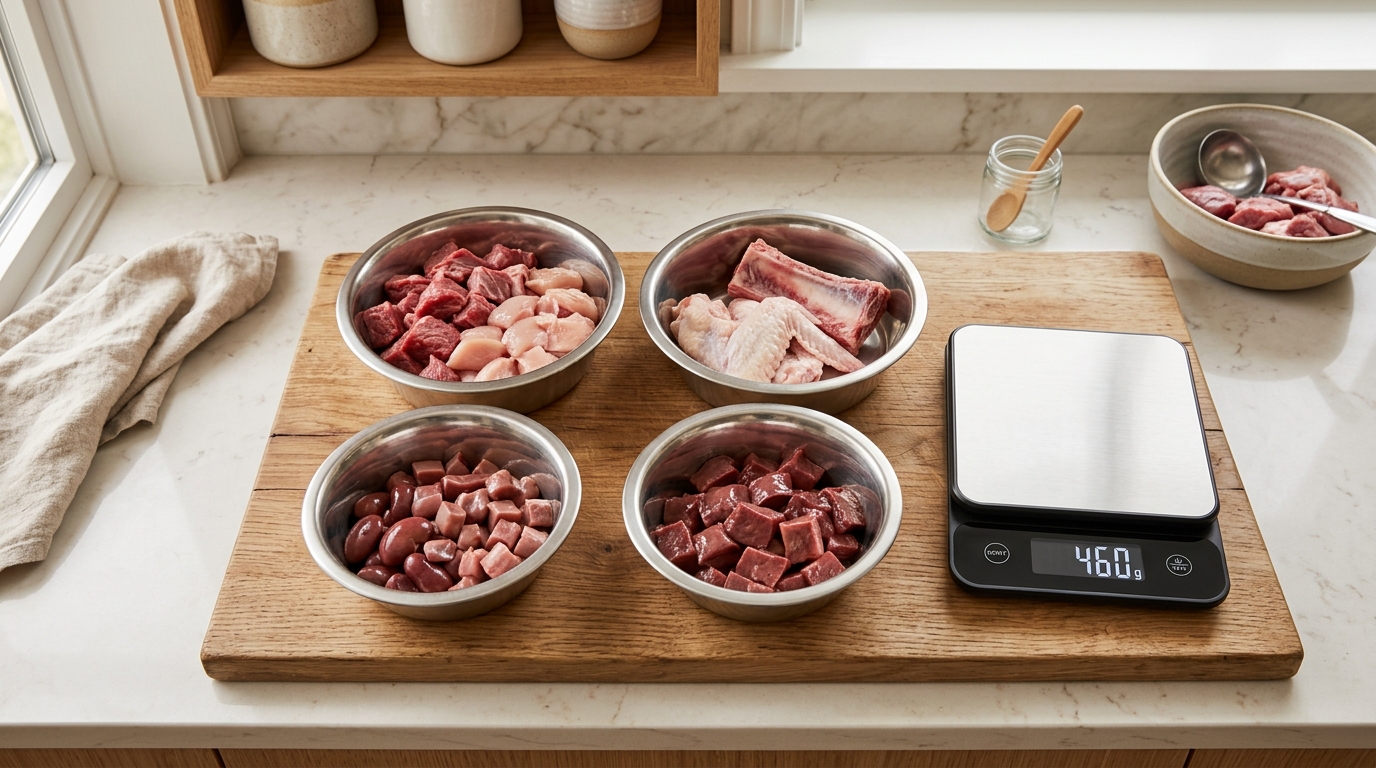
One of the most common questions we hear from people considering raw feeding is: “How much should I actually feed my dog?” It’s a crucial question because getting portion sizes right means your dog stays at a healthy weight, gets proper nutrition, and thrives on their raw diet. The good news? There’s a simple rule that works for most dogs, and we’ll walk you through it in detail. Our free raw dog food calculator helps you get exact portions tailored to your dog’s unique needs.
The Basic Rule: 2-3% of Body Weight
The foundation of raw dog feeding is elegantly simple: most adult dogs need between 2% and 3% of their body weight in raw food per day. This percentage varies depending on your individual dog, but it’s the starting point we use before making adjustments.
Here’s why this works: wild dogs and wolves consume roughly this amount in the wild. When they eat prey, they consume the whole animal—muscle meat, organs, bones, and all—which is nutrient-dense. Our domesticated dogs have similar caloric and nutritional requirements, so this percentage translates beautifully to raw feeding.
Quick Formula:
Daily portion = Dog’s weight in kg × percentage (2-3%) = grams per day
Factors That Affect Your Dog’s Portion Size
Not every dog is the same. Your Lurcher won’t eat the same amount as your Basset Hound, even if they weigh the same. Several factors influence exactly where in that 2-3% range your dog falls:
Age
Puppies burn energy like tiny furnaces and need significantly more food relative to their body weight. Senior dogs typically have lower metabolisms and may need slightly less. We’ll cover exact percentages by age later.
Activity Level
A Border Collie that works on a farm all day burns vastly more calories than a Cavalier King Charles Spaniel that enjoys leisurely park walks. Highly active and working dogs can need 3.5-4% of body weight, whilst sedentary dogs may thrive on 2%.
Metabolism
Some dogs are naturally fast metabolisers—they stay lean even on what seems like plenty of food. Others are more efficient and gain weight easily. This is partly genetic and partly individual variation.
Current Body Condition
If your dog is overweight, you might start at the lower end (2%) and adjust upward as they slim down. If your dog is underweight, start higher and monitor.
Adult Dog Feeding Guidelines by Activity Level
Here’s a breakdown for adult dogs in their prime (1-7 years), based on typical activity levels:
| Activity Level | Percentage | Example: 25kg Dog |
|---|---|---|
| Sedentary/Overweight | 2% | 500g per day |
| Normal/Moderate Activity | 2.5% | 625g per day |
| Active (Daily exercise) | 3% | 750g per day |
| Highly Active (Sports, agility) | 3.5% | 875g per day |
| Working Dogs (Farm, service) | 4% | 1000g per day |
Puppy Feeding Percentages by Age
Puppies are growing rapidly and need considerably more food to fuel that growth. The percentage of body weight needed decreases as they age:
- 2-4 months: 8% of body weight daily (2 meals minimum)
- 4-6 months: 6% of body weight daily (3 meals)
- 6-9 months: 4% of body weight daily (2-3 meals)
- 9-12 months: 3% of body weight daily (2 meals, approaching adult)
Senior Dogs and Special Life Stages
Senior Dogs (7+ years)
Most senior dogs do well on 2-2.5% of body weight daily. Their metabolisms slow down, and excessive weight gain is particularly problematic for older joints. That said, seniors need high-quality nutrition more than ever, so focus on nutrient density rather than quantity.
Pregnant Dogs
Pregnant dogs gradually need more food as pregnancy progresses. Start with 2.5% and increase to 3-3.5% in the second half of pregnancy. In the final weeks, increase to 4-5%.
Nursing Dogs
Lactating mothers need significantly more food to support milk production—often 5-8% of their body weight, depending on litter size. Feed small, frequent meals and monitor condition closely.
Practical Feeding Examples
Let’s make this concrete with real examples for dogs of different sizes:
Small Dog: 10kg Terrier (Active)
At 3% (active): 10kg × 0.03 = 300g per day
This dog might eat 150g at breakfast and 150g at dinner, or split into 3 meals of 100g each.
Medium Dog: 20kg Spaniel (Moderate Activity)
At 2.5% (moderate): 20kg × 0.025 = 500g per day
A typical feeding pattern: 250g breakfast, 250g dinner.
Large Dog: 30kg Labrador (Highly Active)
At 3.5% (highly active): 30kg × 0.035 = 1050g per day
This dog might eat 525g at breakfast and 525g at dinner.
Giant Dog: 45kg German Shepherd (Working)
At 4% (working dog): 45kg × 0.04 = 1800g per day
This high-demand dog needs substantial daily nutrition: 900g at breakfast, 900g at dinner.
How to Tell If You’re Feeding the Right Amount
The percentage rule is a starting point, but your dog’s individual condition is the real guide. You should be able to feel your dog’s ribs easily when you run your hands along their sides, but not see them prominently. This is called optimal body condition scoring. The PDSA provides excellent resources on assessing your dog’s weight and condition.
Signs You’re Feeding Too Much:
- Ribs are hard to feel; fat pad over ribs is visible
- No visible waist when viewed from above
- Belly sags or drags
- Excessive panting or lethargy
Signs You’re Feeding Too Little:
- Ribs, spine, and hip bones are very prominent
- No fat padding over ribs
- Exaggerated waist or tucked belly
- Low energy, poor coat condition, visible hunger
Adjusting Portions Over Time
Your dog’s needs change throughout their life, and even seasonally. A dog that’s highly active during summer months may need less food in winter when they’re less active. Similarly, as dogs age, their metabolism slows, and you’ll need to reduce portions or increase activity to maintain ideal weight.
Start with the calculated percentage and monitor your dog for 2-3 weeks. If they’re gaining weight, reduce by 10% of their current portion. If they’re losing weight or seem hungry, increase by 10%. Make changes gradually and reassess regularly.
Use Our Free Calculator to Get It Right
Whilst these guidelines are solid foundations, every dog is unique. That’s why we created Nature’s Bowl—it takes all these factors into account and generates personalised feeding recommendations for your specific dog. Compare BARF and PMR models to find the approach that suits your dog best. If you’re uncertain about portion sizes for your specific dog, consult your veterinarian or organisations like the Pet Food Manufacturers’ Association for additional guidance.
Simply enter your dog’s weight, age, activity level, and current body condition, and our calculator will tell you exactly how much raw food to feed daily, complete with meal planning suggestions and budget estimates.
Ready to start raw feeding with confidence?
Try Our Free Calculator