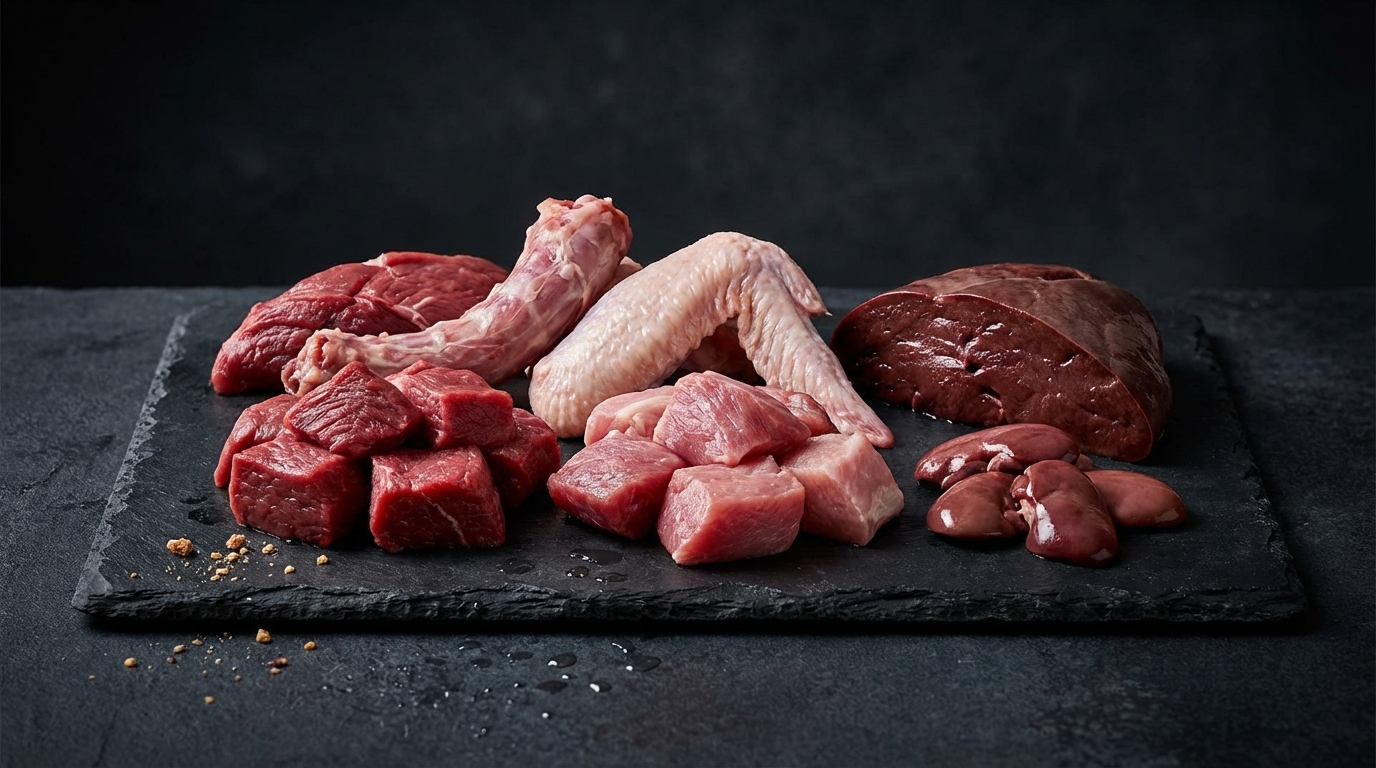
What is PMR?
Prey Model Raw (PMR) is a feeding philosophy grounded in canine ancestral biology. Unlike modern commercial kibble or the BARF method, PMR mimics precisely what a dog would consume in nature: whole prey animals. This approach eliminates all plant matter—no vegetables, no grains, no fruits—focusing exclusively on what a dog's digestive system evolved to process over thousands of years.
The PMR model was developed by practitioners who studied wild canine diets and concluded that the simplest and most effective raw feeding approach replicates the nutritional profile of whole prey. When a wolf brings down a deer, it consumes muscle meat for protein and amino acids, bones for calcium and phosphorus, organs for vitamins and micronutrients, and liver for fat-soluble vitamins. PMR replicates this exact breakdown using the 80/10/5/5 ratio.
The philosophy is elegantly simple: if whole prey animals sustained wild canines for millennia, then a proportionally balanced diet of raw meat, bone, and organs should adequately nourish our domestic dogs. No supplementation required. No cooking required. No processing required. Just real, whole food.
For UK dog owners, PMR offers several advantages: it leverages local meat suppliers, requires minimal preparation, produces less waste than processed food, and often costs less than premium commercial raw brands. Most importantly, many UK dog owners report visible health improvements—shinier coats, cleaner teeth, higher energy, and better digestion—within weeks of switching to PMR.
The 80/10/5/5 Ratio Explained
The foundation of PMR is the 80/10/5/5 nutritional breakdown. Every component serves a specific purpose, and understanding why each percentage matters is crucial to feeding PMR correctly.
80% Muscle Meat
Muscle meat forms the bulk of your dog's diet and provides the essential amino acids, complete proteins, and B vitamins needed for energy, muscle maintenance, and overall function.
What counts as muscle meat? Visible muscle tissue from any protein source. This includes:
- Chicken: breast, thighs, drumsticks, tenders
- Beef: steak, mince, chuck, brisket
- Lamb: leg, shoulder, neck meat
- Turkey: breast, thighs, wings (meat only)
- Pork: chops, shoulder, ribs (meat only)
- Rabbit, duck, venison, goat, game birds
- Offal that counts as muscle meat: heart, tripe (green tripe), cheek, tongue, lung, gizzards, diaphragm
Why Heart is Special
Heart is technically an organ but is counted toward the 80% muscle meat category. This is because its amino acid profile and nutrient density more closely resemble muscle meat than secreting organs. A dog's heart is approximately 75% water, 19% protein, and 3% fat—nearly identical to skeletal muscle. Some PMR feeders count one-quarter of their organ portion as heart.
The importance of variety: Never feed the same protein source for more than 3–5 days consecutively. Different proteins offer different micronutrient profiles. Chicken is rich in selenium; beef provides more zinc; lamb offers different amino acid ratios. Rotating proteins ensures your dog receives a complete nutritional spectrum.
10% Edible Bone
Raw bone provides calcium, phosphorus, and other minerals essential for skeletal health, dental health, and metabolic function. The distinction between "edible" and "weight-bearing" bones is critical—feeding the wrong type can cause digestive issues.
Edible bones (safe for PMR):
- Chicken wings: ~46% bone content—ideal for beginners
- Duck necks: ~50% bone content—soft, easy to digest
- Rabbit ribs: fine, soft bones
- Chicken frames: backbones, ideal for broth
- Turkey necks: larger birds, ~40% bone
- Sprats or other small fish: entire fish, bones fully consumed
- Chicken or rabbit legs: (split lengthwise for safety)
Why Cooked Bone is Dangerous
Cooking changes bone structure. Raw bone remains flexible and crumbles naturally; cooked bone becomes rigid and splinters into sharp fragments that can perforate the digestive tract. Never feed cooked bones.
Weight-bearing bones to avoid: femurs, knucklebones, large leg bones from beef or lamb. These are too dense and can fracture teeth or cause impaction.
Calculating bone percentage: A chicken wing is roughly 46% bone by weight. If feeding a 25kg dog, you need 2.5kg food daily, of which 250g should be bone. Two chicken wings (approximately 150–200g) plus one duck neck (approximately 100–120g) would satisfy this requirement.
5% Liver
Liver is a nutritional powerhouse, containing extraordinary concentrations of vitamin A, B vitamins (especially B12), iron, copper, and selenium. However, liver's potency means it must represent no more than 5% of total food intake.
Which livers are best?
- Beef liver: most widely available in UK, excellent nutritional profile
- Lamb liver: slightly different nutrient balance, good for rotation
- Chicken liver: milder flavour, smaller portions, good for picky eaters
- Pork liver: less commonly used, similar to beef
Hypervitaminosis A Warning
Exceeding 5% liver can cause vitamin A toxicity (hypervitaminosis A). Symptoms include excessive thirst, lameness, stiff gait, and hair loss. This develops over weeks or months of excessive liver feeding, not from isolated incidents. Stick strictly to 5%.
Introducing liver safely: If your dog is new to raw, delay liver introduction until week 3. Start with tiny amounts (10g for a 25kg dog) and increase gradually over 7–10 days to reach full 5% allocation. Some dogs experience loose stools when liver is introduced too quickly.
For a 25kg dog requiring 2.5kg daily, the 5% liver component = 125g. This might be served twice weekly as a 250g serving, alternating with other proteins.
5% Other Secreting Organs
Secreting organs (also called "other organs") are nutrient-dense glands and organs that provide specialised nutrients unavailable in muscle meat or liver. Together with liver, they comprise the 10% "organ meat" portion of PMR.
Common secreting organs:
- Kidney: rich in B12, selenium, iron; supports detoxification
- Spleen: immune support, high in iron
- Brain: rich in omega-3 fatty acids, cholesterol (essential for nervous system)
- Pancreas: contains digestive enzymes naturally
- Testicles (Rocky Mountain oysters): hormonal support, underrated nutrient source
- Thymus (sweetbreads): immune function, rare but valuable
- Eyes: taurine, collagen, though often hard to source
Navigating Availability
Not every organ is available from every supplier. Build a relationship with independent butchers who can order specific items. Many UK butchers have access to organ meats unavailable to home cooks at supermarkets. Ask about beef offal boxes or organ assortments—they're typically inexpensive.
Combining liver and organs: The 10% organ component breaks down as approximately 5% liver and 5% other organs. However, some PMR feeders adjust this slightly—for instance, 4% liver and 6% other organs, as long as liver never exceeds 5% total.
How Much PMR to Feed
The amount of food your dog needs depends on age, activity level, metabolism, and body condition. Most dogs require between 2% and 4% of their body weight daily, though some highly active or working dogs may need more.
| Dog Category | % of Body Weight | When to Use |
|---|---|---|
| Senior Dogs (10+ years) | 2.0% | Lower metabolism, reduced activity |
| Overweight Dogs | 2.0–2.25% | Weight loss without hunger |
| Average Adult Dogs | 2.5–2.75% | Typical maintenance |
| Active Dogs | 3.0% | Regular exercise, walks, play |
| Highly Active/Sports Dogs | 3.5–4.0% | Daily exercise, agility, running |
| Working Dogs | 4.0–5.0% | Shepherds, gun dogs, working breeds |
Puppies: Age-Based Feeding
8 Weeks – 4 Months
8% of body weight, 4 meals daily
Rapid growth phase; high protein requirement
4 – 6 Months
6% of body weight, 3 meals daily
Still growing; begin reducing frequency
6 – 9 Months
4% of body weight, 2 meals daily
Growth continues; transition to twice daily
9 – 12 Months
3% of body weight, 2 meals daily
Near adult size; approaching adult feeding
Pregnant and Nursing Dogs
Pregnancy (weeks 1–4): Feed at normal maintenance level (2.5–3%)
Pregnancy (weeks 5–9): Increase to 4–5% of pre-pregnancy body weight. Growing puppies require significantly more nutrition.
Nursing (first 4 weeks): Increase to 5–8% depending on litter size. Nursing mothers lose tremendous nutrients daily; feed freely if needed.
Nursing (weeks 5–8): Maintain 5–6% as puppies begin eating solid food and nursing reduces.
Worked Example: 25kg Active Adult Dog
Daily requirement: 25kg × 3% = 0.75kg (750g) daily
Breaking down 750g by ratio:
- 80% muscle meat: 600g
- 10% edible bone: 75g
- 5% liver: 37.5g
- 5% other organs: 37.5g
Example meal composition:
500g chicken thighs + 100g chicken wings + 50g beef liver + 50g beef kidney + 50g beef spleen = ~750g
Sample 7-Day PMR Meal Plan
This plan assumes a 20kg average adult dog requiring 550g daily (2.75% of body weight). Adjust quantities proportionally for your dog's weight and activity level. Each meal rotates protein sources to ensure complete nutritional variety.
Day 1: Chicken Base
Morning meal: 400g chicken thighs + 60g chicken wings + 30g beef liver + 30g beef kidney = 520g
Evening meal (optional): 30g chicken necks or skip for fasting day
Day 2: Beef Focus
Morning meal: 420g beef mince + 70g oxtail (bone) + 35g lamb liver + 25g beef spleen = 550g
Evening meal: Fasting or light meal (30g beef)
Day 3: Turkey Variety
Morning meal: 400g turkey thighs + 80g turkey neck + 40g beef liver + 30g beef pancreas = 550g
Evening meal: Light meal or fasting
Day 4: Lamb
Morning meal: 440g lamb shoulder + 55g lamb neck (bone) + 35g lamb liver + 20g lamb kidney = 550g
Evening meal: Fasting day
Day 5: Rabbit (Rotation)
Morning meal: 420g rabbit meat + 65g rabbit ribs (bone) + 30g chicken liver + 35g rabbit kidney = 550g
Evening meal: Light meal
Day 6: Duck
Morning meal: 410g duck breast/leg + 70g duck neck (bone) + 35g beef liver + 35g beef spleen = 550g
Evening meal: Fasting
Day 7: Pork/Venison
Morning meal: 430g pork shoulder + 55g pork ribs (bone) + 35g pork liver + 30g beef thymus = 550g
Evening meal: Light meal or rest
Fasting notes: Many PMR feeders include a fasting day weekly (24-hour period with no food). This mimics natural feeding patterns and supports digestive health. Fasting is optional and not required, but some dogs thrive with it. Always ensure your dog remains healthy and maintains body condition with any feeding schedule.
Protein Rotation Guide
Rotating between multiple protein sources is essential in PMR. Different animals offer different micronutrient profiles, and rotation prevents food sensitivities and ensures nutritional completeness. A healthy PMR diet includes minimum 3–5 protein sources, with 6+ being ideal.
Beginner-Friendly Proteins
- ✓ Chicken: Most affordable, widely available, mild flavour, easy to digest
- ✓ Turkey: Similar to chicken, slightly different nutrient profile, good for rotation
- ✓ Beef: Widely accessible, higher in iron and zinc, excellent nutrition
Advanced/Specialty Proteins
- ✓ Lamb: Richer flavour, different nutrient balance, excellent for rotation
- ✓ Rabbit: Low fat, novel protein, excellent for sensitive dogs
- ✓ Duck, venison, goat, game: Specialty proteins available through butchers
Rotation Strategy
The simplest rotation pattern for beginners: feed one protein for 3–5 days, then switch to another. Never feed the same protein for more than 7 consecutive days.
Example 4-week rotation:
Week 1: Chicken (Mon–Wed), Beef (Thu–Fri), Turkey (Sat–Sun)
Week 2: Beef (Mon–Wed), Lamb (Thu–Fri), Chicken (Sat–Sun)
Week 3: Turkey (Mon–Tue), Rabbit (Wed–Thu), Duck (Fri–Sun)
Week 4: Lamb (Mon–Wed), Venison (Thu–Fri), Chicken (Sat–Sun)
How to Start PMR: Step-by-Step
Introducing PMR requires patience. Most dogs need 2–4 weeks to fully transition, though some adapt within days. Follow this schedule to prevent digestive upset.
Week 1: Muscle Meat Only (ONE Protein)
Feed 100% muscle meat from a single source (e.g., chicken breast and thighs). No bones, organs, or liver yet. This allows the digestive system to adjust to raw food.
Amount: Feed your calculated daily amount (e.g., 2.5% of body weight)
Week 2: Add Edible Bone
Introduce raw edible bones (chicken wings, duck necks). Start with small amounts and observe stools. Some dogs experience mild constipation initially—this is normal.
Target composition: 90% muscle meat, 10% bone
Week 3: Add Liver
Introduce liver very gradually. Start with 5–10g for larger dogs, less for small dogs. Increase by 5g every 2–3 days until you reach 5% of daily intake.
Warning signs: Loose stools indicate too much liver too quickly. Reduce amount and progress more slowly.
Week 4: Add Other Organs
Introduce kidney, spleen, or other organs at 5% of daily intake. Build up gradually if introducing for the first time.
Full ratio achieved: You're now feeding complete 80/10/5/5 PMR
Week 5+: Introduce Protein Rotation
Once stable on the first protein, introduce a second protein (e.g., beef if you started with chicken). Feed for 3–5 days, then rotate back. Gradually add additional proteins.
Expected signs of success: Improved coat, smaller stools, better digestion, increased energy
Transition from Kibble: Go Slow
If transitioning from commercial kibble, you may need an additional 1–2 weeks. Some vets recommend mixing 25% raw with 75% kibble for the first week, then 50/50 for the second week, before moving to 100% raw. Monitor your dog closely.
Adjusting Portions: Body Condition Scoring
Weight tables are only guidelines. The best indicator of correct feeding amounts is your dog's physical appearance and body condition. Learn to assess your dog's condition regularly and adjust portions accordingly.
Underfed (BCS 3/9)
- • Ribs clearly visible, no palpable fat
- • Waist extremely pronounced
- • Abdominal tuck very obvious
- • Visible hip and spine prominences
→ Increase by 0.25% immediately
Ideal (BCS 5/9)
- • Ribs palpable (felt easily) but not visible
- • Clear waist when viewed from above
- • Abdominal tuck present from side
- • Muscle tone visible, good energy
→ Maintain current portion
Overweight (BCS 7/9)
- • Ribs palpable but covered by fat layer
- • Waist absent or only slight
- • Abdominal tuck minimal or absent
- • Fat deposits on spine and hips
→ Reduce by 0.25–0.5%
Monthly Body Condition Assessment
Check your dog's condition monthly. Take photos from above and from the side for comparison. Feel the ribs and spine monthly. Small adjustments (0.25% of daily amount) are more effective than drastic changes. Allow 2–3 weeks to see the effects of portion changes.
Key point: A dog's ideal weight fluctuates seasonally. Dogs often maintain slightly different weight in winter (more muscle, less activity) versus summer (more active, leaner). Monitor condition, not just weight.
Pros and Cons of PMR
Advantages
- ✓ Natural and ancestral: Mimics wild canine diet precisely
- ✓ Visible health improvements: Shinier coat, cleaner teeth, better digestion within weeks
- ✓ Cost-effective: Often cheaper than premium commercial raw or kibble
- ✓ No supplementation required: Whole prey provides complete nutrition
- ✓ Simple to understand: One ratio (80/10/5/5) applies to all dogs
- ✓ Supports local suppliers: Builds relationships with butchers
Disadvantages
- ✗ Requires meal prep: Can't just scoop and serve like kibble
- ✗ Food safety considerations: Must handle raw meat safely (hygiene, storage)
- ✗ Initial learning curve: Understanding ratios and portions takes effort
- ✗ Sourcing organs: Not all suppliers stock kidney, spleen, etc.
- ✗ Vet skepticism: Some vets unfamiliar with raw feeding
- ✗ Travel complications: Requires planning for holidays or boarding
Common PMR Mistakes to Avoid
1. Feeding Too Much Bone
Symptoms: hard stools, constipation, straining. Remember: only 10% should be bone. Most bones are denser than meat, so you need less volume than you think. A whole chicken leg is not "10% of the meal" by volume.
2. Exceeding Liver (Over 5%)
Excess liver causes vitamin A toxicity. Over weeks or months, this leads to lameness, joint stiffness, and hair loss. Weigh your liver portions carefully and never exceed 5% of daily food intake.
3. Not Rotating Proteins
Feeding only chicken for months may cause nutritional imbalances and food sensitivities. Rotate minimum 3–5 proteins across a month. Different proteins provide different micronutrients.
4. Feeding Cooked Bones
Cooked bones become rigid and splinter. Never feed any cooked bones—not even "softened" or "steamed" bones. Always use raw, frozen, or defrosted raw bones.
5. Not Weighing Food
Eyeballing portions is imprecise. Different meats have different densities. A 400g chicken thigh looks very different from 400g of ground beef. Invest in scales and weigh all components daily.
6. Transitioning Too Quickly
Switching from kibble to raw overnight often causes loose stools and digestive upset. Follow the 4–5 week transition plan. Go slowly, especially if your dog is older or has previous digestive issues.
7. Ignoring Body Condition Changes
Some dogs maintain the same weight but become overweight due to reduced activity or high food amount. Monitor body condition monthly, not just weight. Adjust portions based on appearance, not the scale.
8. Not Sourcing Quality Organs
Poor quality organs reduce nutritional value. Build a relationship with independent butchers who can provide fresh, human-grade organ meat. Avoid organs from unknown sources or very cheap suppliers.
Frequently Asked Questions
Is PMR safe for puppies?
Yes, PMR is excellent for puppies when portions and ratios are correct. Use the age-based percentages (8% for 8 weeks – 4 months, reducing to 3% by 9–12 months). Ensure sufficient calcium from bone. Many breeders start litters on PMR at 3–4 weeks. Consult your vet for your specific puppy's needs.
Can I feed PMR alongside kibble?
Yes, many people feed "mixed" diets—raw for one meal, kibble for another. However, separate meals by at least 4–6 hours to allow proper digestion of each. Mixing raw and kibble in the same meal is not recommended as they digest at different rates.
What if my dog won't eat organs?
Some dogs are picky. Mix organs with meat they like, feed organs at a different time, or try different organ types. Liver is usually more palatable than kidney. Never force organ consumption; work gradually. Some people lightly freeze organs or feed them as part of a "meatball" with preferred meat.
How do I handle raw feeding for holidays or boarding?
Plan ahead. For holidays, pre-portion and freeze meals in labelled containers. Provide detailed feeding instructions to carers. Some boarding facilities accommodate raw feeding; ask in advance. Alternatively, temporarily switch to kibble during short trips (a few days of kibble won't harm a healthy dog). Return to PMR gradually afterward.
Should I fast my dog one day per week?
Weekly fasting is optional, not required. Some PMR feeders find their dogs thrive with a 24-hour fast weekly (mimicking natural feast-famine patterns). Others feed daily without issue. If you choose fasting, ensure it's brief and your dog remains healthy. Seniors, puppies, and certain health conditions may not suit fasting. Monitor your individual dog.
Do I need supplements on PMR?
No. When correctly formulated with proper organ ratios and variety, PMR provides complete nutrition without supplements. Whole prey contains everything a dog needs. However, if your dog has specific health conditions, your vet may recommend targeted supplements (e.g., omega-3 for joint health). Always discuss with your vet before supplementing.
Is PMR more expensive than kibble?
PMR is often similar to or cheaper than premium kibble. Local butchers frequently offer bulk discounts on organ meat and seconds (items slightly damaged but perfectly safe). Some UK feeders spend £1–2 per day per dog, less than many commercial raw brands. Budget-conscious feeding requires building supplier relationships and planning ahead.
What about food safety and bacteria?
Dogs' stomach acid is far stronger than humans' and kills most bacteria raw meat carries. Salmonella and E. coli rarely harm dogs. That said, practice basic hygiene: wash surfaces, use separate cutting boards, don't leave food out beyond 2 hours, freeze portions promptly. Handle raw meat as you would for human consumption—dogs are better equipped than humans to handle pathogens.
Ready to Start PMR?
Use our free PMR calculator to determine your dog's exact portions and create a personalised feeding plan.
Calculate Your Dog's Portions