How to Calculate Raw Dog Food Portions: UK Owner’s Guide
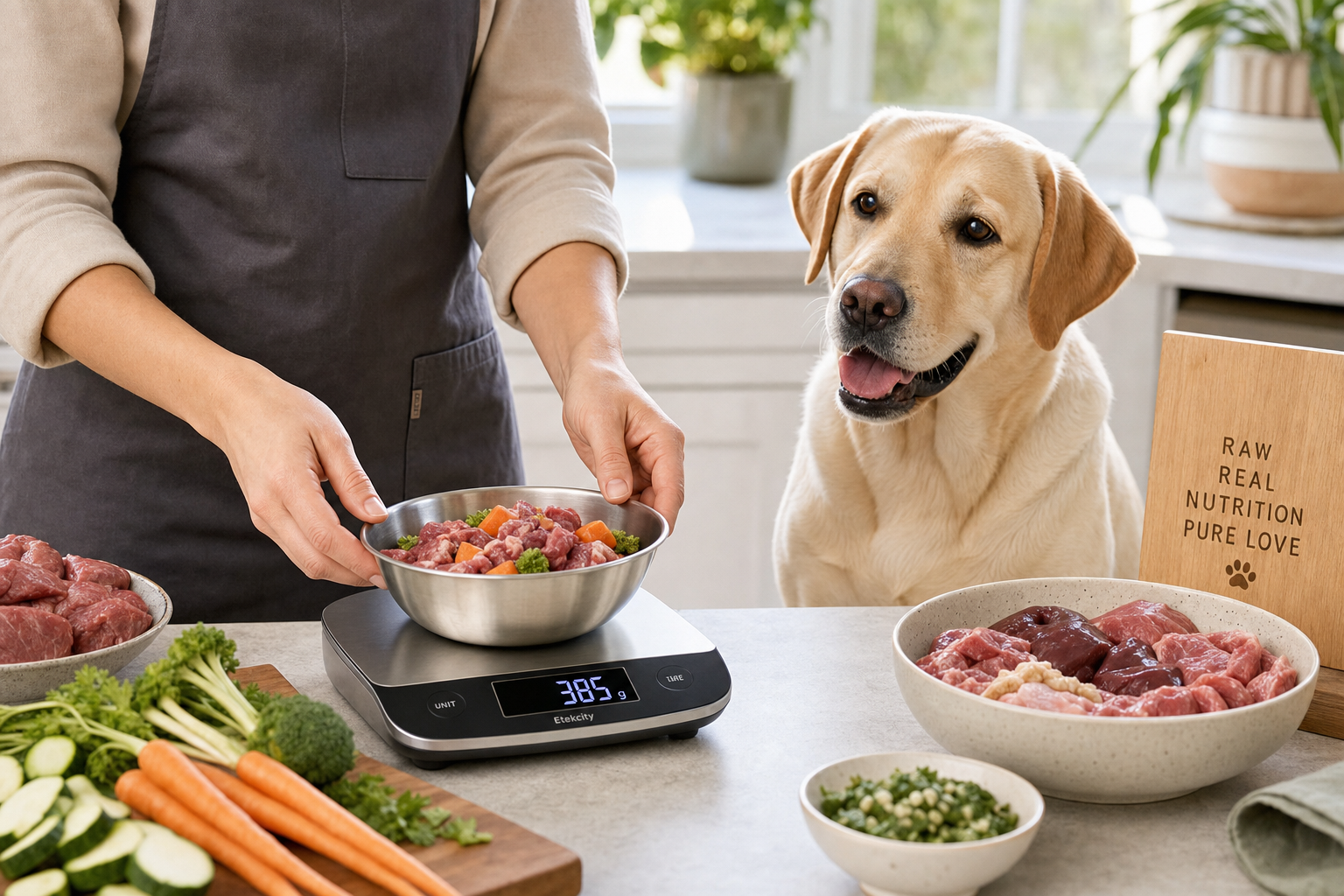
Knowing how to calculate raw dog food portions is the single most important practical skill you need before switching your dog to a raw diet. Get it right and your dog will thrive — lean, energetic, and healthy. Get it wrong and you risk underfeeding a growing puppy, over-fattening a couch-loving Spaniel, or leaving an active working dog running on empty.
This guide walks you through the exact method UK raw feeders use every day, including a simple step-by-step calculator, a handy reference table, and the key adjustments that make the difference between a good diet and a great one. Once you understand how to calculate raw dog food portions accurately, the whole process becomes quick and straightforward to repeat every few months as your dog’s needs change.
The 2–3% Body Weight Rule Explained
The foundation of raw feeding is elegantly simple: feed 2–3% of your dog’s ideal adult body weight per day. This figure comes from decades of practical experience among raw feeders and broadly mirrors what a wild canid would consume relative to its size. To calculate raw dog food portions using this rule, all you need is your dog’s ideal weight and a digital kitchen scale.
The percentage you choose within that range depends on your individual dog:
- •2% of body weight — ideal for less active dogs, older dogs, or those prone to weight gain.
- •2.5% of body weight — a solid starting point for most adult dogs at a healthy weight with moderate activity.
- •3% of body weight — suited to highly active dogs, working dogs, and dogs with fast metabolisms that struggle to hold weight.
Always feed to ideal body weight, not current weight. If your dog is overweight, use the weight they should be — feeding to an inflated figure will keep them fat. If they are underweight, use a realistic healthy target and monitor progress weekly. UK owners who calculate raw dog food portions using the 2–3% rule consistently find this the simplest and most reliable starting point available.
Daily Raw Food Amounts by Dog Weight
Use this reference table to find your dog’s daily raw food amounts quickly. Figures are daily totals in grams, rounded to the nearest 5g for ease of weighing. It is straightforward to calculate raw dog food portions at home once you know your dog’s target weight and have identified the right percentage band.
| Dog Weight (kg) | 2% Daily (g) | 2.5% Daily (g) | 3% Daily (g) |
|---|---|---|---|
| 5 kg | 100g | 125g | 150g |
| 10 kg | 200g | 250g | 300g |
| 15 kg | 300g | 375g | 450g |
| 20 kg | 400g | 500g | 600g |
| 25 kg | 500g | 625g | 750g |
| 30 kg | 600g | 750g | 900g |
| 35 kg | 700g | 875g | 1,050g |
| 40 kg | 800g | 1,000g | 1,200g |
| 45 kg | 900g | 1,125g | 1,350g |
| 50 kg | 1,000g | 1,250g | 1,500g |
All figures are daily totals. Split across meals as appropriate for your dog’s age and routine. Weigh on digital kitchen scales for accuracy.
How to Calculate Raw Dog Food Portions: Step-by-Step
Follow these four steps to work out the right daily amount for your specific dog. You only need a set of kitchen scales and your dog’s current (or target ideal) weight. The easiest way to calculate raw dog food portions is to work through these steps in order — the maths takes less than a minute.
- 1. Weigh your dog. Use a bathroom scale: weigh yourself, then weigh yourself holding the dog, and subtract. For dogs over 30 kg, ask your vet to weigh them at the next visit. Note their ideal weight — not current weight if they are over or underweight.
- 2. Convert to grams. Multiply the ideal weight in kilograms by 1,000. A 20 kg dog = 20,000g to work with.
- 3. Choose your starting percentage. Use 2% for low-activity or weight-prone dogs; 2.5% for most healthy adult dogs; 3% for very active or lean dogs. Multiply: 20,000g × 0.025 = 500g per day.
- 4. Divide across meals. Most adult dogs are fed twice daily. 500g ÷ 2 = 250g per meal. Puppies need three to four meals; use the puppy percentages in the section below.
Review after two weeks. Look at your dog’s body condition — you should feel the ribs easily but not see them. Adjust up or down by 10% and reassess. You should recalculate raw dog food portions every few months, or whenever your dog’s weight, activity level, or life stage changes significantly.
Adjustments for Puppies, Seniors, and Activity Level
Puppies have dramatically higher energy and nutrient requirements per kilogram of body weight than adults. When you calculate raw dog food portions for a puppy, the standard approach is to base the amount on their expected adult weight rather than their current size, using the following percentages:
- •2–8 months: 5–6% of expected adult body weight per day, split across 3–4 meals.
- •9–12 months: 4% of expected adult body weight per day, split across 2–3 meals.
- •12–18 months (large breeds): 3% until skeletal growth is complete.
Senior dogs (generally 7+ years, or earlier for giant breeds) typically need slightly less food as their metabolism slows and activity reduces. Start at 2% and monitor body condition closely. When you calculate raw dog food portions for an older dog, err on the lower side initially and adjust upward only if body condition deteriorates. Some seniors with health conditions require specific adjustments — the British Veterinary Association recommends consulting your vet before making significant dietary changes, particularly if your dog has kidney, liver, or joint issues.
Activity level is the most variable factor in day-to-day raw feeding. A Labrador that runs 10 miles with a runner owner will need significantly more than the same dog spending two weeks in kennels. Learning to calculate raw dog food portions correctly means accounting for these day-to-day variations, not just setting a fixed figure and forgetting it. Consider these practical adjustments:
- •Working days (gun dogs, agility, canicross): Increase by 20–30% on training and competition days.
- •Rest days or holiday periods: Drop back to 2% or reduce by 10–15%.
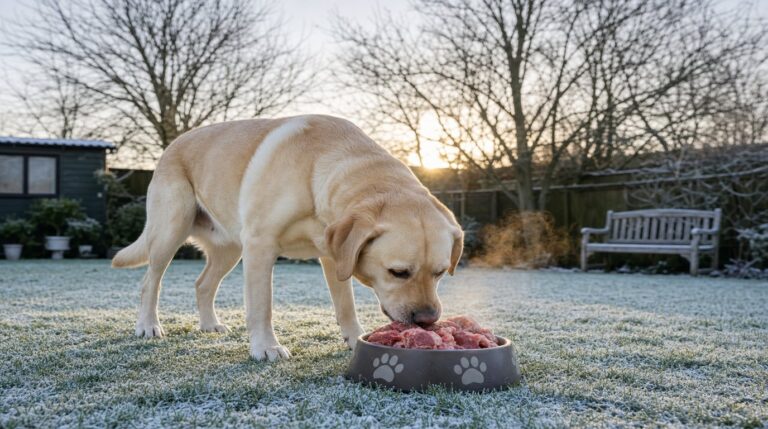
- •Seasonal variation: Many dogs eat slightly more in winter to maintain body temperature.
How to Split Raw Portions Across Meals
For most healthy adult dogs, two equal meals a day — morning and evening — works well. This mirrors what many kibble-fed dogs are used to and fits around typical UK working schedules. Once you calculate raw dog food portions for the full day, simply divide the total evenly across the number of meals you plan to give. However, there are good reasons to vary this:
- •Large and giant breeds (German Shepherds, Great Danes, Mastiffs) benefit from two meals to reduce the risk of bloat — never one large meal per day. When you calculate raw dog food portions for these breeds, always divide the total into at least two servings.
- •Small breeds with fast metabolisms can sometimes do better with three smaller meals rather than two larger ones, especially if they seem hungry or restless.
- •Dogs transitioning from kibble often do well with one raw meal and one kibble meal initially, then switching fully over 2–3 weeks.
Once-a-day feeding is practised by some raw feeders with adult dogs and can be appropriate for certain individuals, but it is not recommended as a default starting point. If you are unsure which meal frequency suits your dog, calculate raw dog food portions for the day first, then trial different splits over a week to see what keeps your dog most settled.
What Your Calculated Portions Should Contain
Knowing how much to feed is only half the picture — the other half is knowing what that portion should be made of. The most widely used framework in the UK is the 80/10/10 ratio (sometimes 80/10/5/5 for more detail). Whenever you calculate raw dog food portions, apply this breakdown to the daily total to ensure each meal is nutritionally balanced:
| Component | Percentage | Examples |
|---|---|---|
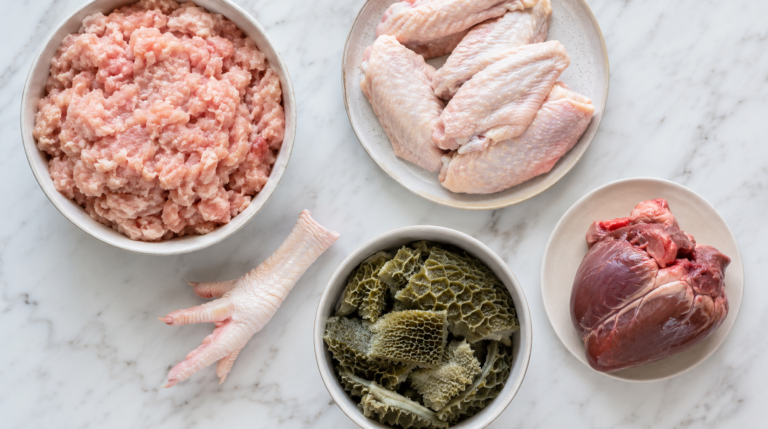
| Muscle meat | 80% | Chicken breast, beef mince, lamb, pork, turkey, rabbit |
| Raw meaty bone | 10% | Chicken wings, duck necks, lamb ribs, whole prey |
| Secreting offal | 10% | Liver (max 5%), kidney, spleen, pancreas, brain |
For a 20 kg dog eating 500g/day: that’s 400g muscle meat, 50g raw meaty bone, and 50g offal — of which no more than 25g should be liver. Some owners also add 10% fruit and vegetables in place of a portion of muscle meat (the 70/10/10/10 model), but this is optional.
Common Mistakes When You Calculate Raw Dog Food Portions
- ✗Using current weight when overweight. Feeding 3% of an obese 35 kg dog that should weigh 28 kg massively overfeeds them. Always use ideal weight.
- ✗Forgetting to weigh. Eyeballing portions introduces significant error — a digital kitchen scale costing under £10 removes all guesswork.
- ✗Not adjusting for treats and extras. Training treats, bones, and chews all count toward daily intake. A large marrow bone can contain several hundred calories.
- ✗Feeding puppies adult percentages. Puppies on 2–2.5% of current body weight will be underfed. Use expected adult weight at higher percentages as described above.
- ✗Never revisiting the calculation. A dog’s needs change with age, seasons, activity, and health. Review portions every 4–8 weeks — it only takes a few moments to calculate raw dog food portions afresh and confirm you are still in the right range.
When to Adjust Raw Portions
The body condition score (BCS) is your most reliable feedback tool. Run your hands firmly along your dog’s ribcage — and use what you find to calculate raw dog food portions that are slightly higher or lower as needed:
- •Can’t feel ribs at all, or have to press hard: Reduce daily amount by 10%. Reassess in two weeks.
- •Ribs easily felt with light pressure, not visible: Ideal. Maintain current portions.
- •Ribs very prominent, visible spine, loss of muscle mass: Increase by 10–15%. If weight loss continues despite increased feeding, consult your vet.
Other signs you may need to adjust: Loose stools (reduce offal, reduce bone if constipated — or increase if stools are loose), persistent hunger between meals (slight increase may be needed), reduced energy or dull coat (review the balance of the diet and consider a nutritional audit).
Life events that commonly trigger a portion review include neutering (metabolic rate drops by roughly 30% — reduce accordingly), pregnancy and lactation (significant increase required, especially in the final trimester and during nursing), recovery from illness or surgery, and starting or stopping a regular exercise routine. In each of these cases, take five minutes to calculate raw dog food portions from scratch rather than making vague adjustments by eye.
Calculate Your Dog’s Portions Instantly
Use our free raw dog food calculator to get an instant, accurate portion size based on your dog’s weight, age and activity level. It’s the fastest way to calculate raw dog food portions without any manual maths — no guesswork needed.
Try Our Free CalculatorFrequently Asked Questions
How do I calculate raw dog food portions for a puppy?
Puppies need significantly more food than adults relative to their body weight. To calculate raw dog food portions for a puppy, feed 5–6% of their expected adult body weight daily, split across 3–4 meals. As they approach adult size (typically 12–18 months depending on breed), gradually reduce to the standard 2–3% adult maintenance rate.
Should I calculate raw dog food portions by ideal or actual weight?
Use your dog’s ideal body weight, not their current weight — especially if they are overweight. Whenever you calculate raw dog food portions, feeding 2–3% of an already-overweight dog’s current weight will maintain or worsen the problem. Ask your vet for guidance on ideal body weight if you are unsure.
What is the 80/10/10 rule when calculating raw dog food portions?
The 80/10/10 rule means 80% muscle meat, 10% raw edible bone, and 10% organ meat (of which at least half should be secreting organ like liver or kidney). Applying this framework every time you calculate raw dog food portions ensures a nutritionally balanced raw diet that meets your dog’s requirements for protein, calcium, phosphorus and micronutrients.
The Bottom Line
The method to calculate raw dog food portions is straightforward: 2–2.5% of ideal adult body weight per day for most healthy adult dogs, weighed on digital scales every single feed, structured to the 80/10/10 ratio of muscle meat, bone, and offal, and reviewed against body condition every two weeks. Adjust up if your dog is too lean; reduce if they are gaining unwanted weight. The more consistently you calculate raw dog food portions using the same method each time, the quicker you will build an accurate intuition for what your individual dog needs.
No formula is a substitute for observation. The dogs that do best on raw are owned by people who weigh carefully, watch closely, and adjust confidently. You have the tools — now trust the process.