Bulk Buying Raw Meat UK: 9 Smart Ways to Save in 2026
Bulk buying raw meat is the single biggest lever UK owners have to bring the cost of feeding raw down to — or below — the cost of mid-range kibble. Done well, bulk buying raw meat trims 30–50% off your weekly bill, gives you better quality control, and stops the constant top-up shop. This 2026 guide walks through where to source, how much to order, what freezer you actually need, and how to portion safely. For background on weekly portion sizes, pair it with our how much raw food guide and our wider budget raw feeding guide.
Why Bulk Buying Raw Meat Saves So Much in 2026
Most pre-portioned raw food on UK shelves carries a 40–80% mark-up over the underlying meat price. You’re paying for branded packaging, single-tray portion sizes, supermarket logistics, and a chiller cabinet running 24 hours a day. Bulk buying raw meat strips most of that out — you buy 5–20kg cases direct from a wholesaler, butcher, or farm, then portion at home.
The savings compound. According to the PDSA, the average UK dog owner spends around £80–£105 a month on food. Bulk buying raw meat regularly drops that figure into the £35–£60 range for medium dogs, and turns a multi-dog household from “expensive hobby” into “manageable monthly cost”. A 25kg adult Labrador eating 2.5% of bodyweight needs roughly 19kg of food a month — at £2.30/kg in bulk versus £4.80/kg pre-portioned, that’s a saving of £47 every single month.
The Real Cost Difference: Bulk vs Pre-Portioned
Here’s how 2026 prices typically compare across the most popular UK proteins, based on a snapshot of butcher quotes, raw food wholesalers (DAF, Nutriment, Bulmer Pet Foods, Natures Menu), and the Pet Food Manufacturers’ Association feeding guidance:
| Protein | Pre-portioned (£/kg) | Bulk (£/kg) | Saving |
|---|---|---|---|
| Chicken mince & bone | £3.90 | £1.80 | 54% |
| Turkey mince | £4.60 | £2.40 | 48% |
| Beef mince | £5.20 | £2.80 | 46% |
| Lamb mince | £6.40 | £3.60 | 44% |
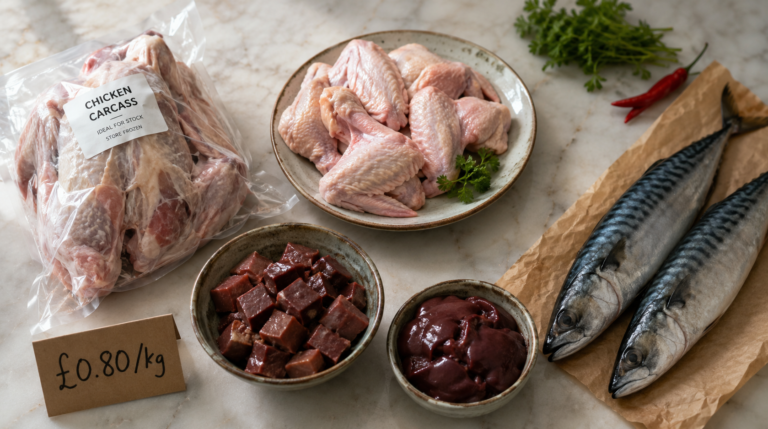
| Chicken carcasses | £2.20 | £0.80 | 64% |
| Beef offal pack | £5.80 | £2.90 | 50% |
The headline: bulk buying raw meat in 5kg+ cases pays for itself within the first order, even after factoring in freezer-running costs (around £40 a year for a small chest freezer at current UK electricity rates).
Where to Buy: The Best UK Sources for Bulk Raw Meat
UK raw feeders are spoiled for choice in 2026. Each source has a sweet spot — most experienced bulk buyers use two or three in rotation.
Local butchers
The cheapest and most flexible source. Most independent butchers will save chicken carcasses, lamb ribs, beef offcuts, and trim if you ask — often for 50p–£1.50 per kg. Ring round on a Monday morning, ask for the “pet trade” rate, and offer to collect midweek when offcuts pile up. Halal and kosher butchers are especially good for whole hearts, kidneys, and lamb necks at very low per-kg prices.
Raw food wholesalers
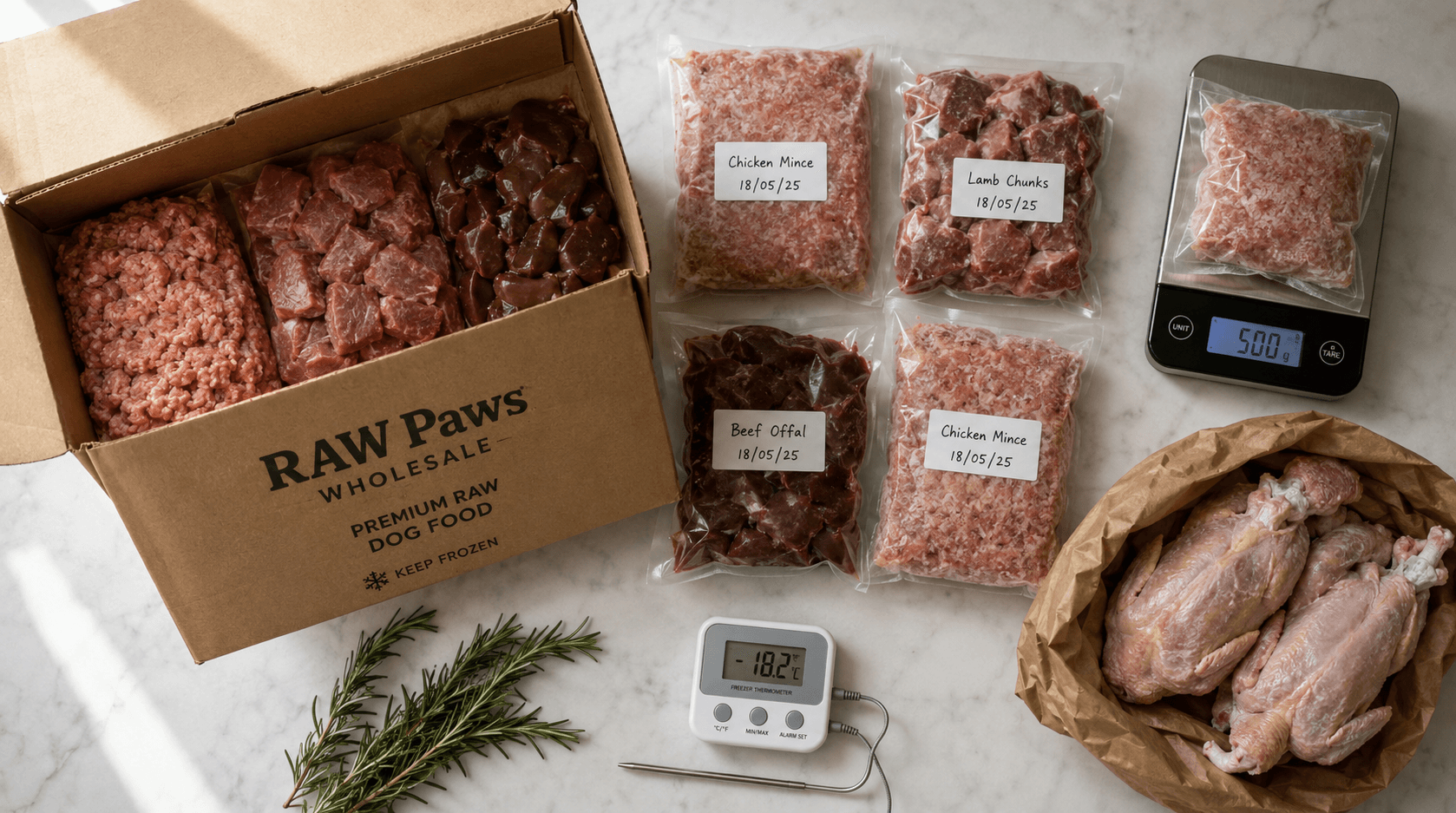
Companies like DAF (Durham Animal Feeds), Bulmer Pet Foods, Paleo Ridge, Nutriment, and Natural Instinct all sell case-sized bulk packs (usually 10–20kg) shipped frozen. Minimum orders typically start at £75–£150 with free delivery above £100. Ideal for proteins your butcher can’t get hold of: duck, rabbit, venison, tripe, and pre-balanced complete minces.
Farm shops & game dealers
Excellent for seasonal value: rabbit, venison, pigeon, and pheasant in the autumn/winter shooting months can drop to £1.50–£3 per kg in bulk. Many estates near you will sell whole carcasses if you ask. Game adds variety and is naturally lean — perfect for active dogs.
Supermarkets & online wholesalers
Don’t overlook the big players. Whole frozen chickens, whole mackerel, lamb breasts, and chicken wings regularly hit reduced sections — Tesco, Morrisons, and Asda all run yellow-sticker discounts of 30–70% on meat approaching its use-by date. Stick it straight in the freezer the same day. Online sites like Musclefood and Tom Hixson sell wholesale-style cases too.
Local raw feeding co-ops
Search Facebook for “[your county] raw feeders” — most regions have a co-op that pools orders to hit wholesale minimums and split delivery fees. Joining one is the single fastest way to access pallet-rate pricing without needing a giant freezer yourself.
Freezer Setup for Bulk Buying Raw Meat
Freezer space is the practical constraint that decides how much bulk buying raw meat actually saves you. Too small, and you can’t take advantage of the best wholesale deals. Too big and you’re paying to chill empty space. Use the table below as a starting point:
| Dog size | Daily intake | Monthly bulk order | Recommended freezer |
|---|---|---|---|
| Small (5–10kg) | 125–250g | 4–8kg | Drawer in upright (60L) |
| Medium (10–20kg) | 250–500g | 8–15kg | Small chest (100–150L) |
| Large (20–35kg) | 500–875g | 15–26kg | Mid chest (200–250L) |
| Giant or 2+ dogs | 875g+ | 26kg+ | Large chest (300L+) |
A second-hand chest freezer from Facebook Marketplace usually costs £40–£120 and pays for itself in two or three bulk orders. Look for one with an A+ or A++ energy rating to keep running costs sensible. Always position the freezer in a cool garage or utility room — a hot kitchen forces it to work harder and shortens compressor life.
How Much Raw Meat Should You Buy at Once?
The sweet spot for bulk buying raw meat is 4–8 weeks of supply per order. Less than that and you’re not really benefiting from wholesale rates. More than that and you start losing on freezer burn, variety, and the energy cost of holding stock.
Quick formula: daily grams × 30 × number of months you want to cover ÷ 1,000 = kg to order. For a 25kg dog eating 500g a day across an 8-week order, that’s 500 × 30 × 2 ÷ 1,000 = 30kg. Split that 30kg across roughly 70% muscle meat, 10% edible bone, 10% offal (5% liver), and 10% non-meat extras like raw eggs, tripe, or oily fish.
If you’re new to all this, our free raw dog food calculator works out the exact weekly weights for your dog so you can convert them into a single bulk order in seconds.
Storage, Hygiene & UK Food Safety Rules
Bulk buying raw meat works only if you store it properly. The UK Food Standards Agency guidance for raw pet food handling mirrors the rules for raw meat for human consumption — and protects both you and your dog.
- • Freeze at −18°C or colder. Use a thermometer to check; cheap freezers often run warmer than the dial suggests.
- • Defrost in the fridge, not on the counter. Allow 24 hours per kg. Use the thawed meat within 48–72 hours.
- • Separate raw from human food. Use a dedicated bottom shelf or sealed tubs. Wash hands and surfaces with hot soapy water after handling.
- • Vacuum-sealed bags last 6–9 months in the freezer; standard freezer bags 3–4 months. Label every parcel with the protein and date.
- • Never refreeze fully thawed meat. Once defrosted in the fridge, feed it; don’t put it back in the freezer.
Portioning Bulk Raw Meat: A Step-by-Step System
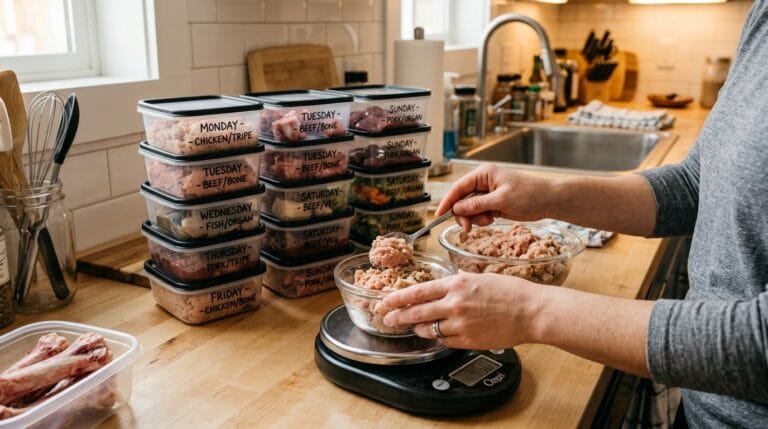
The number-one reason new raw feeders give up on bulk buying raw meat is the portioning dread — the idea of spending a Saturday afternoon with 20kg of mince and a stack of bags. With a system it takes 45–60 minutes per bulk order. Here’s the workflow most experienced UK raw feeders settle into:
- Order arrives partially thawed. Most wholesalers ship in insulated boxes. Move everything to the freezer immediately, then schedule your portioning session for 24 hours later.
- Defrost two days’ worth in the fridge. Mince is much easier to portion when soft but still cold.
- Weigh out daily portions. Use kitchen scales and ziplock bags or silicone moulds (muffin trays work well for small dogs).
- Vacuum-seal where possible. A basic vacuum sealer (£40–£70) extends freezer life from 3 to 9 months and prevents freezer burn.
- Label and freeze flat. Flat-frozen bags stack tightly, defrost faster, and let you see what’s left at a glance.
- Rotate stock. Newest bags go to the bottom, oldest to the top. First in, first out.
Splitting Bulk Orders: Multi-Dog Households & Co-Ops
For multi-dog households, bulk buying raw meat moves from “nice to save” to “essential”. Three medium dogs eating 400g a day each will burn through 36kg a month. A 30kg case of chicken-and-bone mince at £1.80/kg costs £54 — versus £140 for the same in pre-portioned trays.
If you’ve only got one dog, team up. A two-household co-op of three dogs total can hit the £100 free-delivery threshold most wholesalers require, halve the per-kg cost, and give both freezers manageable 12–15kg loads. Run the order on a shared spreadsheet, take it in turns to drive to the depot, and split the offal pack — most owners find sharing a 5kg liver block far easier than using one alone.
Common Bulk Buying Raw Meat Mistakes to Avoid
The same handful of mistakes catches almost every new bulk buyer. They’re all easy to dodge:
- • Buying too much variety, too little volume. Three proteins in 5kg cases beats nine proteins in 1kg packs every time.
- • Skipping the offal calculation. A 5kg liver pack feeds an average dog for 5–6 months. Order accordingly or split with a friend.
- • No freezer thermometer. The £6 best investment any bulk buyer makes.
- • Forgetting the 80/10/10 ratio. Bulk buying raw meat without balancing muscle meat, bone, and offal turns into cheap-but-incomplete feeding. Brush up via our PMR guide or BARF guide.
- • Buying before transitioning. If your dog hasn’t switched to raw yet, follow our transition guide first — order one week’s supply, see how they take to the new protein, then commit to a bulk order.
- • Ignoring the Pet Food Manufacturers’ Association labelling guidance. If a wholesaler can’t tell you the species, cut, and country of origin, walk away.
Frequently Asked Questions
Is bulk buying raw meat actually cheaper than kibble?
For medium and large dogs, yes — comfortably. Bulk buying raw meat at £1.80–£2.80 per kg compares favourably with mid-range kibble at £4–£6 per kg once you adjust for the higher feeding weight raw requires. Premium kibble (£8–£12/kg) is always more expensive than bulk raw.
Can I bulk buy raw meat from a regular supermarket?
You can, but the savings are smaller. Supermarket whole chickens, lamb breasts, and reduced-section meat work well as supplements to a wholesale order — not as your main supply. The mark-up on small packs is too high for full bulk-buying economics.
How long does bulk-bought raw meat last in the freezer?
Vacuum-sealed: 6–9 months for muscle meat, 4–6 months for oily fish, 9–12 months for raw bones. In standard freezer bags: roughly half those times. Always label with the freeze date.
Do I need a separate freezer for bulk buying raw meat?
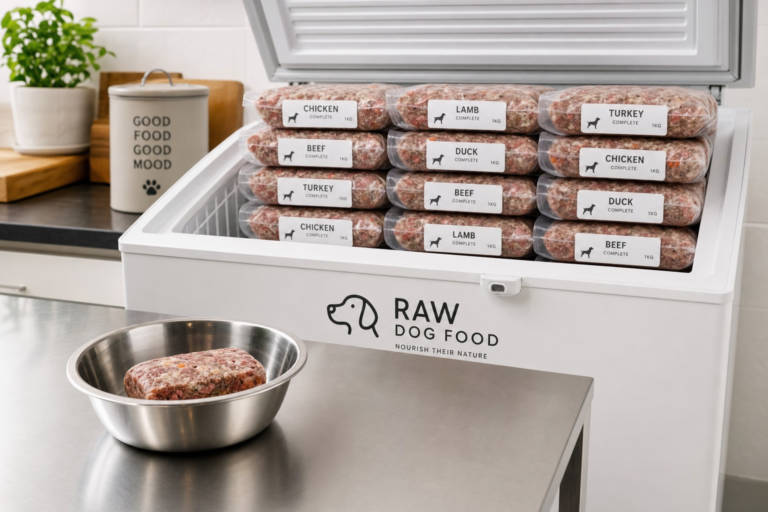
Strongly recommended once you’re feeding more than one medium dog. A dedicated chest freezer separates raw pet food from human food (good for hygiene), gives you flexible capacity for big orders, and keeps your kitchen freezer free for everyday use.
What’s the minimum order size for UK raw food wholesalers in 2026?
Most start at £75–£100 for free or discounted delivery, equivalent to roughly 25–40kg of mixed proteins. Below that you’ll pay £8–£15 in courier charges, which usually wipes out the bulk discount on a small order.
The Bottom Line
Bulk buying raw meat is the highest-impact change a UK raw feeder can make. Source from a mix of butchers, wholesalers, and a local co-op; size your freezer to hold 4–8 weeks of supply; portion with a system; stick to the 80/10/10 ratio; and follow basic UK food-hygiene rules. Done well, you’ll cut your raw feeding bill by 30–50%, feed better-quality meat, and never run out mid-week again. In 2026 it’s still the smartest, simplest way to make raw feeding sustainable for the long term.
Plan Your Bulk Order in Minutes
Use our free UK raw dog food calculator to work out exactly how much muscle meat, bone, and offal your dog needs per week — then multiply up to your ideal bulk order size. Built for UK feeders, with kg and £ throughout.
Try Our Free Calculator