Weaning Puppies Onto Raw: A Safe UK Guide for 2026
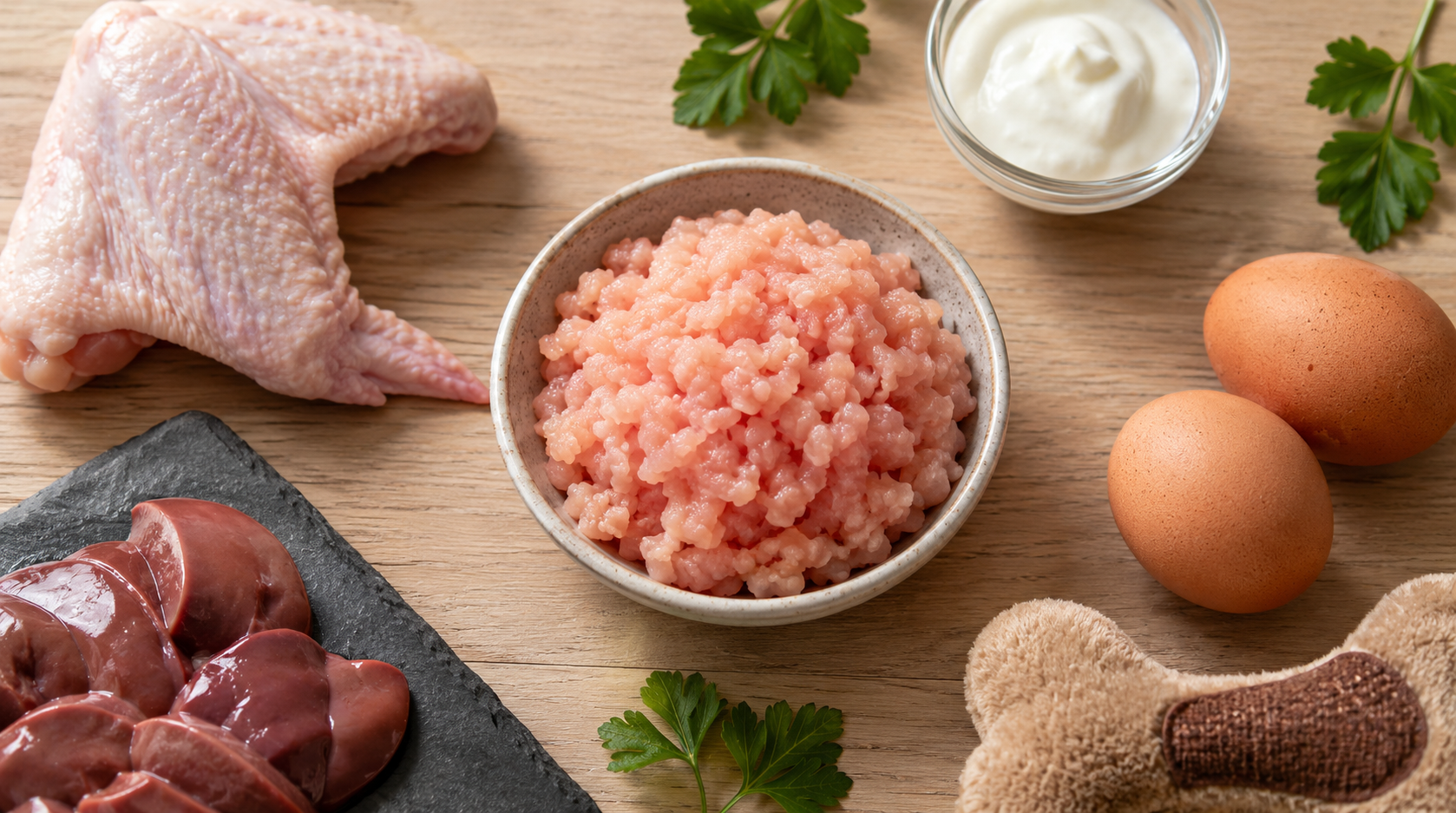
Weaning puppies onto raw food is one of the most rewarding ways to start a young dog’s life — and one of the easiest to get slightly wrong. This 2026 UK guide walks you through exactly when to begin weaning puppies onto raw, how to build a balanced first meal, the safest proteins to introduce, portion sizes for every breed size, and the common mistakes that catch new breeders and owners out. Whether you’re a breeder weaning a litter or an owner bringing home an 8-week-old pup, this is your step-by-step plan. For broader context, pair this with our UK puppy raw feeding guide and our PMR guide.
When To Start Weaning Puppies Onto Raw
Weaning puppies onto raw food typically begins between 3 and 4 weeks of age, when puppies start showing interest in their mother’s meals and their first teeth break through. The window for full transition runs from around week 3 to week 7 or 8, by which point pups should be eating four small raw meals a day independently.
If you’re an owner collecting an 8-week-old pup that’s already weaned onto kibble, the principles still apply — you’ll simply use a slower, gentler transition rather than starting from milk. The Pet Food Manufacturers’ Association recommends prioritising age-appropriate nutrition through every life stage, and a properly balanced raw diet meets those needs from the very first solid meal.
| Puppy age | Stage | What to feed |
|---|---|---|
| 0–3 weeks | Milk only | Mother’s milk or puppy milk replacer |
| 3–4 weeks | First taste | Finely minced raw chicken slurry, alongside milk |
| 4–6 weeks | Mostly raw | Minced raw meals 3–4× daily, reducing milk |
| 6–8 weeks | Fully weaned | Complete raw meals, 4× daily |
Why Raw From The Start Matters
Puppies fed a biologically appropriate diet from weaning enjoy a smoother microbiome transition than those switched from kibble months later. Their immature digestive systems learn to handle natural proteins, fats and bone without the inflammation many owners later associate with kibble. Studies cited by the British Veterinary Association highlight how early diet shapes lifelong gut health, joint development and immune function.
Raw fed pups also tend to develop strong jaw muscles, cleaner teeth and steadier growth rates — particularly important for large and giant breeds where rapid weight gain on calorie-dense kibble is linked to skeletal problems. If you’re considering the BARF approach instead of PMR, our complete BARF guide explains the differences and how each model suits puppies. Weaning puppies onto raw also sets up taste preferences early — many kibble-only dogs later refuse raw, whereas pups raised on it accept new proteins enthusiastically for life.
7 Easy Steps for Weaning Puppies Onto Raw
This is the proven sequence UK breeders use for weaning puppies onto raw safely over four weeks. Stick to one protein at a time and don’t rush — pups will tell you when they’re ready for the next stage.
- 1. Days 1–3 (week 3): Offer a teaspoon of finely minced raw chicken breast, blended into a smooth slurry with warm water. Place it on a flat plate so multiple pups can investigate.
- 2. Days 4–7: Increase the slurry to one tablespoon per pup, twice a day. Add a pinch of finely ground egg yolk for fat and choline.
- 3. Week 4: Move to slightly chunkier minced chicken with finely ground bone (chicken wings minced through a grinder work well). Offer four small meals a day.
- 4. Week 5: Add a second protein — minced turkey or duck — on alternate days. Introduce a small amount of organ meat (around 5% liver) for the first time.
- 5. Week 6: Begin offering soft edible bone like minced chicken necks. Start to coarsen the mince so pups practise chewing.
- 6. Week 7: Move to chunked meat rather than mince. Add a red meat protein such as minced lamb or beef. Total daily food should sit at 8–10% of bodyweight.
- 7. Week 8 onwards: Fully weaned. Continue four meals a day until 12 weeks, then drop to three. Mother is no longer needed nutritionally.
Building a Balanced Raw Meal for Weaning Puppies
When weaning puppies onto raw, every meal still follows the same 80/10/10 prey model ratios as adults — but with a slightly higher bone content (12–15%) to support growth, and care to keep liver under 5% of the meal in the early weeks. Here’s how a balanced meal breaks down:
Muscle meat — around 75%
Lean muscle meat forms the bulk of every meal. Start with chicken breast, then introduce turkey, duck, lamb and beef one protein at a time over the first month. Avoid pre-seasoned or marinated supermarket meat.
Edible bone — 12–15%
Pups need more calcium than adults to fuel skeletal growth. Use finely minced chicken wings, necks or carcass mince. Never feed weight-bearing bones, and always grind bone for pups under 8 weeks. See our raw bones for dogs UK guide for the safest options.
Liver — 5%
Liver is dense in vitamin A, B vitamins and iron. Introduce just a pinch at week 5 and build up gradually — too much too soon can cause loose stools. Chicken or lamb liver are easiest on developing guts.
Other secreting organ — 5%
Kidney, spleen or pancreas round out the mineral profile. Introduce after liver is well tolerated (around week 6). If your butcher only sells liver, you can run a slightly higher liver ratio temporarily.
Optional puppy extras
A whole raw egg with shell (twice weekly) provides choline, healthy fat and natural calcium. A teaspoon of plain natural yoghurt or kefir supports the developing microbiome. Avoid vegetables until at least 12 weeks unless your vet advises otherwise.
Portion Sizes During Weaning
Puppies eat a far higher percentage of bodyweight than adults — typically 8–10% during weaning, tapering down as they grow. Always split the daily total across four meals to keep blood sugar steady. The table below shows approximate daily totals for healthy pups.
| Puppy weight | % bodyweight | Daily food | Per meal (×4) |
|---|---|---|---|
| 1 kg | 10% | 100 g | 25 g |
| 3 kg | 10% | 300 g | 75 g |
| 5 kg | 8% | 400 g | 100 g |
| 8 kg | 8% | 640 g | 160 g |
| 12 kg | 7% | 840 g | 210 g |
Weigh weekly. Adjust portions by ±10% based on body condition — you should feel ribs easily without seeing them. When weaning puppies onto raw, portion accuracy matters far more than at any later life stage, so don’t eyeball it. For breed-specific projections, run the numbers through our free raw dog food calculator.
Safe First Proteins When Weaning Puppies Onto Raw
Not every protein is equal at this delicate stage. The safest first proteins for weaning puppies onto raw are lean, low-fat poultry that’s easy to mince finely. Save richer proteins for week 5 or later, once digestion has settled.
- • Chicken breast (week 3): The textbook starter. Cheap, low-fat, easy to source from any UK supermarket. Around £4–£6 per kg.
- • Turkey mince (week 4): Slightly leaner than chicken, gentle on tummies. Look for plain mince with no added water.
- • Duck (week 5): A nutrient-rich novel protein. Richer in iron and zinc — ideal as a second protein.
- • Lamb (week 6): The first red meat in the rotation. Higher fat, so build up slowly.
- • Beef (week 7): Lean beef mince introduces another red protein. Avoid fatty cuts until pups are over 12 weeks.
Avoid pork in the first month unless it’s pre-frozen for three weeks (UK guidance on Aujeszky’s disease, see the Food Standards Agency). Also hold off on oily fish like salmon and mackerel until 8 weeks, when whole sardines become a brilliant omega-3 addition.
Common Mistakes When Weaning Puppies Onto Raw
Most issues people report when weaning puppies onto raw come down to a handful of avoidable errors. Recognise them early and the whole transition becomes much smoother.
- • Introducing too many proteins at once — start with chicken alone. Add a new protein only every 5–7 days.
- • Skipping bone or grinding it wrong — puppies on bone-less diets risk calcium deficiency within weeks. Always include 12–15% ground bone.
- • Feeding cold from the fridge — pups eat best at room temperature. Take meals out 20 minutes early or warm with a splash of hot water.
- • Over-feeding fat — duck legs and lamb mince contain more fat than chicken. Trim visible fat in the first month.
- • Free-feeding all day — leaving raw food out for hours grows bacteria and removes meal structure. Pups should finish each meal in 5–10 minutes.
- • Forgetting to weigh — pups outgrow portions every week. A 5kg lab pup at 8 weeks may need 700g a day by 10 weeks.
For more pitfalls common across all life stages, see our 10 common raw feeding mistakes article.
Hygiene, Storage & Safety
Weaning puppies onto raw means raw meat in the kitchen — and pups are messier than adult dogs. The PDSA emphasises the same kitchen hygiene rules whether you’re handling raw food for humans or pets. Apply common-sense practice:
- • Defrost meals in the fridge for 12–24 hours. Never refreeze fully thawed raw meat.
- • Use stainless steel bowls or ceramic — easy to disinfect after each meal.
- • Wash hands and surfaces with hot soapy water immediately after preparing meals.
- • Keep a dedicated chopping board for raw pet food, ideally a different colour.
- • Portion meals into freezer-safe tubs in advance — a fortnight’s worth saves time and money.
Vulnerable adults, young children or immunocompromised household members should not handle raw pet food directly.
Frequently Asked Questions
At what age should I start weaning puppies onto raw?
Begin at 3 to 4 weeks of age, when puppies start showing interest in solid food and their first teeth emerge. Full transition should be complete by 7 to 8 weeks.
Can I switch an 8-week-old kibble-fed puppy to raw?
Yes. Use a slow 7–10 day transition rather than a sudden swap. Start with 25% raw mixed with 75% kibble, increasing the raw portion every two days. Our transition guide covers the full process.
How much should a puppy eat when weaning onto raw?
Aim for 8–10% of current bodyweight per day, split across four meals. A 5kg pup needs roughly 400g daily. Reweigh weekly and adjust.
Is weaning puppies onto raw safe for large breeds?
Yes — and often safer than calorie-dense kibble that drives rapid growth. Aim for steady, lean development by keeping calcium at 12–15% bone content and avoiding over-feeding fat.
Do raw fed puppies need supplements?
A balanced 80/10/10 raw diet with whole eggs and occasional oily fish meets nearly all needs when weaning puppies onto raw. Many breeders add a small amount of green-lipped mussel powder for joints once pups are 12 weeks old.
The Bottom Line
Weaning puppies onto raw food is straightforward when you follow a structured plan. Start with finely minced chicken at 3–4 weeks, build up through the prey model ratios over four weeks, and have pups fully transitioned by 7–8 weeks. Keep bone content at 12–15%, introduce proteins one at a time, weigh weekly, and stick to four meals a day until 12 weeks. Get those fundamentals right and you set your pup up for a lifetime of strong joints, clean teeth and steady, healthy growth.
Calculate Your Puppy’s Daily Raw Portions
Use our free UK raw dog food calculator to work out exactly how much muscle meat, bone and organ your puppy needs each day — adjusted automatically for age, weight and growth rate.
Try Our Free Calculator