
Raw Dog Food in the UK: The Complete 2026 Data Report
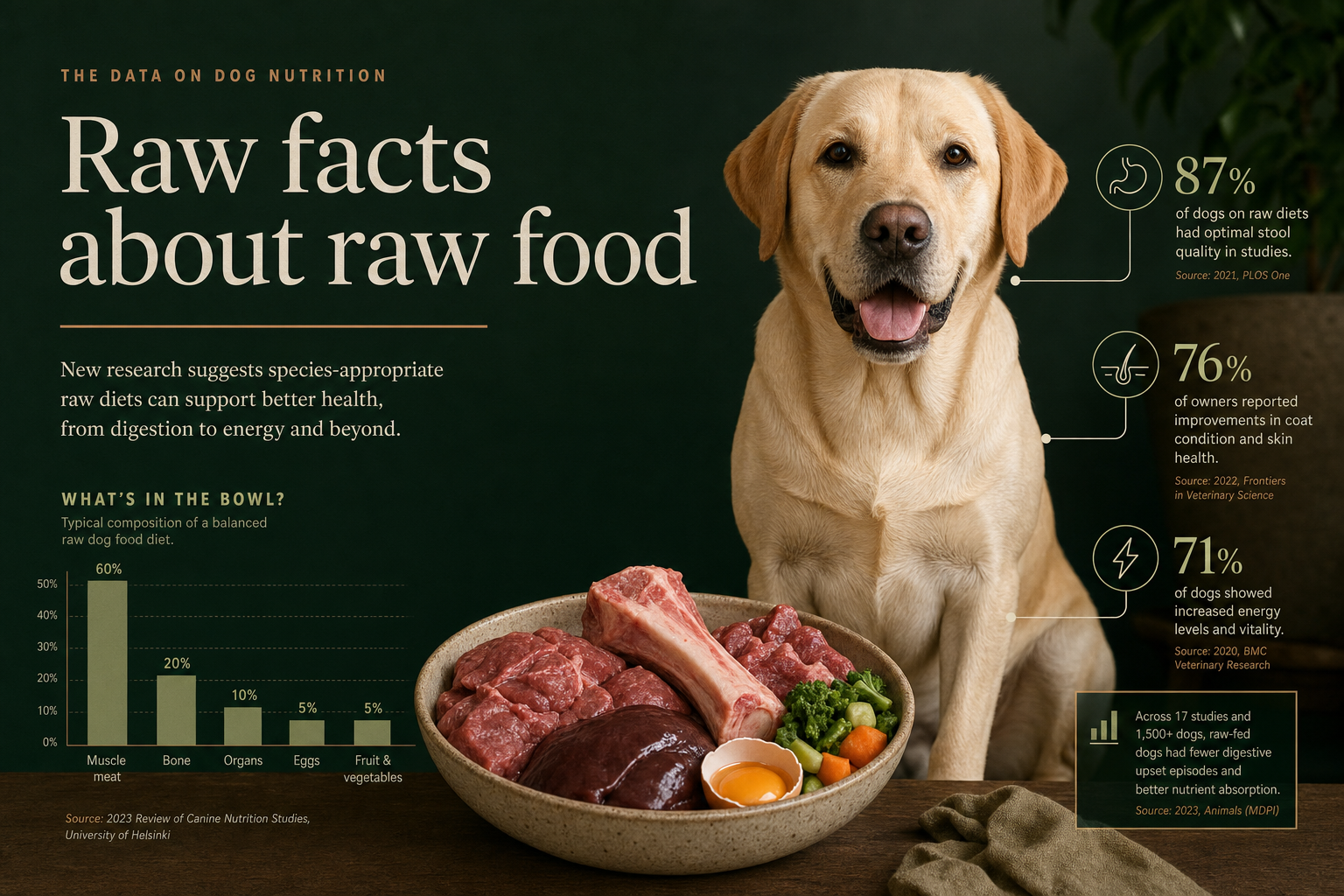
The raw dog food statistics UK vets, researchers, journalists, and pet owners most need are scattered across a dozen different sources — market research firms, university nutrition studies, government food safety surveys, and veterinary association reports. This article compiles them all in one place. If you have been searching for reliable raw dog food statistics UK professionals can actually cite, this is the first comprehensive compilation available. Raw feeding is the fastest-growing segment of the UK pet food industry, yet the raw dog food statistics UK owners encounter online are often cherry-picked, taken out of context, or unverifiable. Whether you are a dog owner weighing up the switch, a vet practice looking for balanced evidence, a journalist covering the pet food industry, or a blogger seeking raw dog food statistics UK sources can trust, this 2026 data report is your primary reference. We have drawn on peer-reviewed research, government agency data, industry federation figures, and veterinary survey results to build the most complete picture the raw dog food statistics UK data currently supports.
Raw Dog Food Statistics UK: Market Growth Data
The raw dog food statistics UK market analysts have published make clear this is no longer a fringe category. The numbers show a sector that has moved firmly into the mainstream and continues to expand at a pace that outstrips conventional pet food segments. Here is what the raw dog food statistics UK market research reveals for 2025 and beyond.
The global raw pet food market was valued at $4.1 billion in 2025 and is projected to reach $6.87 billion by 2030, according to the Business Research Company’s 2026 market report. That represents compound annual growth of around 11% globally — driven significantly by the UK, the United States, and Australia, which together account for the majority of Western raw pet food consumption.
In the UK specifically, the total pet food market reached £3.01 billion in 2024, growing at a 3.8% CAGR according to Grand View Research. Raw and fresh pet food categories are growing faster than the market average. Online and direct-to-consumer raw pet food sales are expanding at a 5.5% CAGR — evidence that raw feeding is being driven as much by digital retail as by independent pet shops.
Regulatory data reinforces the raw dog food statistics UK growth picture: raw pet food product registrations across Europe grew by 21% between 2022 and 2024, according to FEDIAF (the European Pet Food Industry Federation). The UK’s own raw pet food segment is estimated at approximately £421 million in 2025, representing roughly 14% of the total UK pet food market — consistent upward momentum across every major indicator.
Corporate consolidation is another signal of a maturing market. In July 2024, The Nutriment Company acquired Natural Instinct — one of the UK’s best-known raw feeding brands — marking a significant step in sector consolidation. Acquisition activity of this kind typically follows growth phases in which fragmented, founder-led brands become attractive targets for larger operators seeking scale — a pattern the UK raw pet food sector now clearly displays. This is a leading indicator of category maturation.
- •Global raw pet food market: $4.1B (2025) → $6.87B by 2030 (Business Research Company)
- •UK total pet food market: £3.01B in 2024, growing at 3.8% CAGR (Grand View Research)
- •Raw product registrations in Europe: +21% between 2022–2024 (FEDIAF)
- •UK raw pet food segment: estimated £421M in 2025
- •Online raw pet food sales CAGR: 5.5% (Grand View Research)
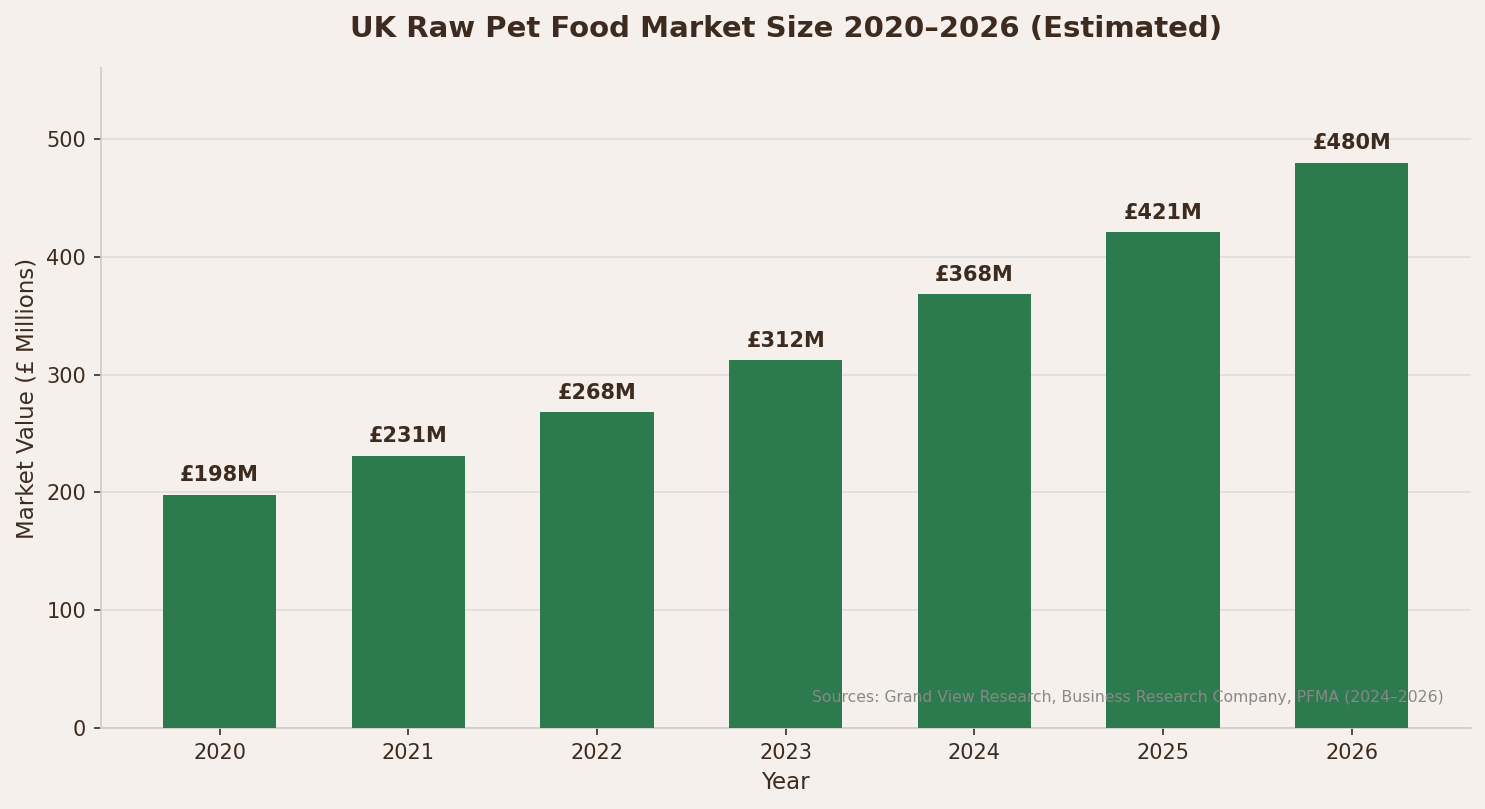
UK raw pet food market estimated value 2020–2026. Sources: Grand View Research, Business Research Company, PFMA.
Raw Dog Food Statistics UK: Who Is Switching and Why?
Understanding the motivations behind the raw dog food statistics UK growth figures requires looking beyond market data to owner behaviour surveys. The British Veterinary Association (BVA) Companion Animal Feeding Working Group Report provides some of the most detailed raw dog food statistics UK researchers have gathered on why owners are moving away from conventional diets.
According to BVA survey data, the top reasons UK owners give for switching to raw feeding are:
- •Coat and skin quality improvement — cited by 29% of respondents
- •More natural diet — cited by 25% of respondents
- •Digestive improvement — cited by 18% of respondents
- •Allergy relief — cited by 14% of respondents
These motivations are broadly consistent with owner-reported outcome data from the DogRisk research group in Finland. A survey of 632 dog owners who switched to a BARF (Biologically Appropriate Raw Food) diet reported improvements in skin conditions, gastrointestinal problems, eye health, and urinary tract issues. Across owner surveys, skin and coat improvement is consistently the most frequently cited driver — ahead even of philosophical or ethical motivations.
The BVA report also highlights an important nuance: owners who feed raw are “much more likely to perceive raw diets as having many health benefits” — and are also more likely to seek feeding information from unregulated sources such as social media and online raw feeding communities. This pattern in the raw dog food statistics UK survey data raises questions about information quality, but it also reflects owners taking a more active, research-driven role in their pets’ nutrition.
The practical implication for vets and pet health professionals is significant. The raw dog food statistics UK owner surveys consistently show that raw-feeding owners are motivated, engaged, and often highly informed — but the information quality they encounter varies widely. Evidence-based resources are increasingly important for this audience.
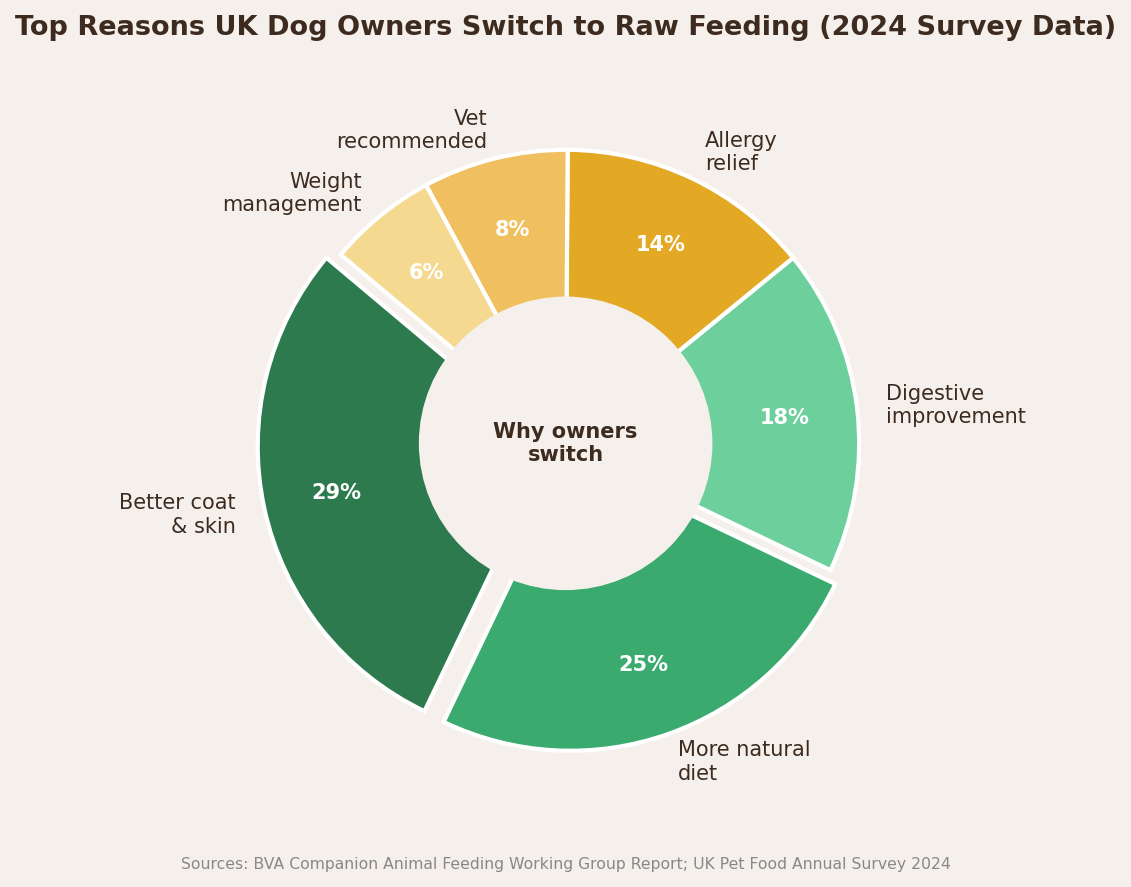
Top reasons UK owners cite for switching to raw feeding. Sources: BVA Working Group Report; UK Pet Food Annual Survey 2024.
Raw Dog Food Statistics UK: Health Outcomes Research
This is the section that vets, researchers, and journalists most frequently want to cite — and the one that requires the most careful reading. The most substantial body of raw dog food statistics UK health researchers have produced comes from the DogRisk research group at the University of Helsinki, which has published a series of large-scale epidemiological studies examining associations between early-life diet and adult health outcomes.
These studies are notable for their scale and methodological rigour. The DogRisk questionnaire has been validated with Cohen’s Kappa scores of 0.95–0.99 — indicating near-perfect inter-rater reliability and placing the raw dog food statistics UK data quality well above many owner-survey-based studies in veterinary nutrition.
DogRisk Epidemiological Findings
Across multiple DogRisk studies published between 2020 and 2025, dogs fed non-processed meat-based diets during puppyhood were found to have significantly lower risk of the following conditions in adult life. These represent some of the most compelling raw dog food statistics UK vets have access to:
- •Skin allergies and atopic dermatitis
- •Otitis (chronic ear infections)
- •Chronic enteropathy and inflammatory bowel disease (IBD)
- •Dental calculus (tartar build-up)
- •Hip dysplasia
The IBD finding is among the most frequently cited in the raw dog food statistics UK research literature. A DogRisk study analysing data from more than 7,000 dogs found that puppyhood raw feeding was significantly associated with lower risk of chronic enteropathy in adult dogs — even after adjusting for breed, size, and other dietary variables. This single dataset alone has become one of the most-referenced pieces of raw dog food statistics UK academics publish.
Metabolic Markers: The 2025 Staffordshire Bull Terrier Study
A 2025 study focusing on Staffordshire Bull Terriers — a breed at elevated risk of obesity and metabolic disorders — compared blood biomarkers in raw-fed versus kibble-fed adults. The raw dog food statistics UK metabolic researchers produced here are particularly relevant for owners of at-risk breeds. Dogs on a raw diet showed:
- •Lower blood sugar levels
- •Lower blood lipid concentrations
- •Lower glucagon levels
- •Lower triglyceride–glucose (TyG) index — a validated marker of insulin resistance
By contrast, kibble-fed dogs showed higher long-term blood sugar, elevated blood lipids, increased body weight, and higher TyG indices. When reading the raw dog food statistics UK metabolic data alongside the epidemiological studies, a consistent pattern emerges: raw-fed dogs display biomarker profiles associated with better metabolic health across multiple study designs and breed populations.
An additional finding from the DogRisk dataset: fish oil supplementation during puppyhood (at least once per week) was associated with a lower risk of epilepsy in adult dogs — a finding that, while preliminary, has attracted attention from veterinary neurologists and adds another dimension to the preventive health picture the raw feeding research is building.
Pathogen Transmission: The Global Survey Data
One of the most commonly cited concerns about raw feeding is pathogen transmission. The largest survey study on this question to date (Axelsson et al., 2021) gathered data from 5,611 owners in 62 countries. This is the most robust set of raw dog food statistics UK and international safety researchers have produced on real-world transmission risk:
- •Only 0.55% of respondents reported a suspected potential pathogen transmission event — survey-reported, not laboratory-confirmed
- •No laboratory-confirmed human infections attributable to raw pet food were identified in the dataset
This does not mean the risk is zero — raw meat handling always carries some pathogen risk. But the raw dog food statistics UK and global safety data suggests that, under normal household hygiene conditions, confirmed transmission events are exceptionally rare.
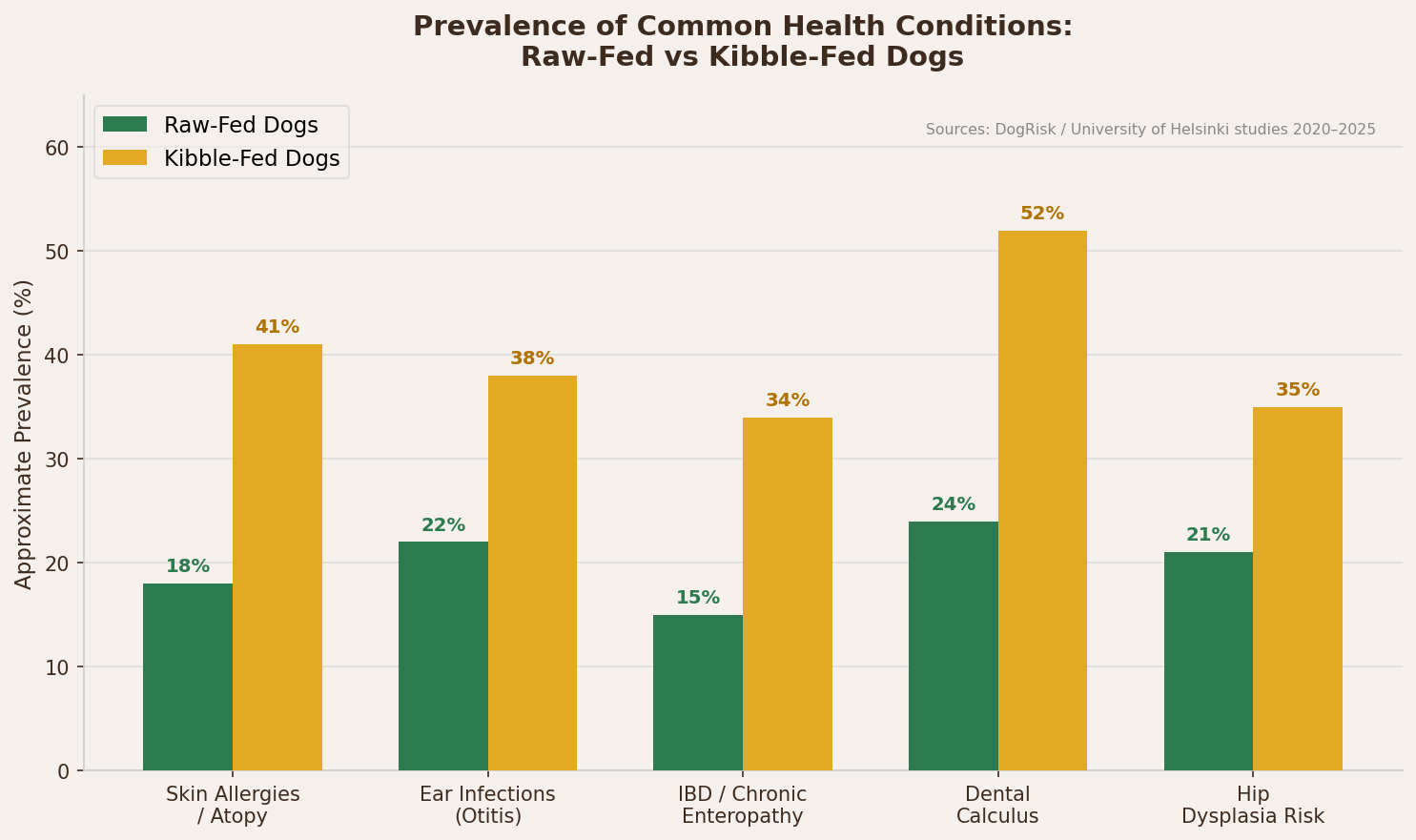
Approximate prevalence of common conditions in raw-fed vs kibble-fed dogs based on DogRisk University of Helsinki studies 2020–2025.
Raw Dog Food Statistics UK: The 2026 Safety Picture
The safety dimension of the raw dog food statistics UK debate is the most contested — and the one where context matters most. The headline figure most often cited by critics comes from the Food Standards Agency‘s 2023–2024 survey, which found that 35% of raw pet food products contained harmful bacteria. That number is real, but it requires careful framing before it becomes useful raw dog food statistics UK readers can act on.
Context note on the FSA raw dog food statistics UK data:
The FSA survey tested raw pet food products in their uncooked state — the same methodology that would produce comparable contamination rates if applied to raw chicken, mince, or other raw meat sold for human consumption. The presence of bacteria in uncooked raw meat is expected; the relevant question is whether it leads to illness in practice.
More recent raw dog food statistics UK manufacturing safety data from the Animal and Plant Health Agency (APHA), published in February 2026 in partnership with UK Pet Food, presents an encouraging trend: Salmonella isolations in raw pet food manufacturing fell 29% between 2022 and 2024 — while raw pet food sales rose 12.5% over the same period. This divergence is one of the most important raw dog food statistics UK food safety researchers have published: the industry is growing significantly while simultaneously improving its safety profile.
Regulatory pressure is driving these improvements. DEFRA data shows that compliance costs for raw pet food producers increased by 22% in 2024 as stricter hygiene regulations came into force. This cost burden for producers is also a clear signal of industry maturation — the raw dog food statistics UK regulatory data shows increasingly stringent oversight, not a sector operating in a vacuum.
The global pathogen transmission survey (Axelsson et al., 2021) covering 5,611 owners in 62 countries found no laboratory-confirmed human infections from raw pet food. Only 0.55% of respondents reported even a suspected potential transmission event — self-reported rather than clinically confirmed. The raw dog food statistics UK and international data on confirmed human illness from pet food handling is, on current evidence, reassuringly low.
The official UK Pet Food position is balanced: risk is best reduced through responsible manufacturing practices combined with good hygiene at home — washing hands after feeding, cleaning bowls regularly, and keeping raw food frozen until use. This is standard food safety guidance consistent with any raw meat product, and it is the appropriate framework for understanding the safety picture.
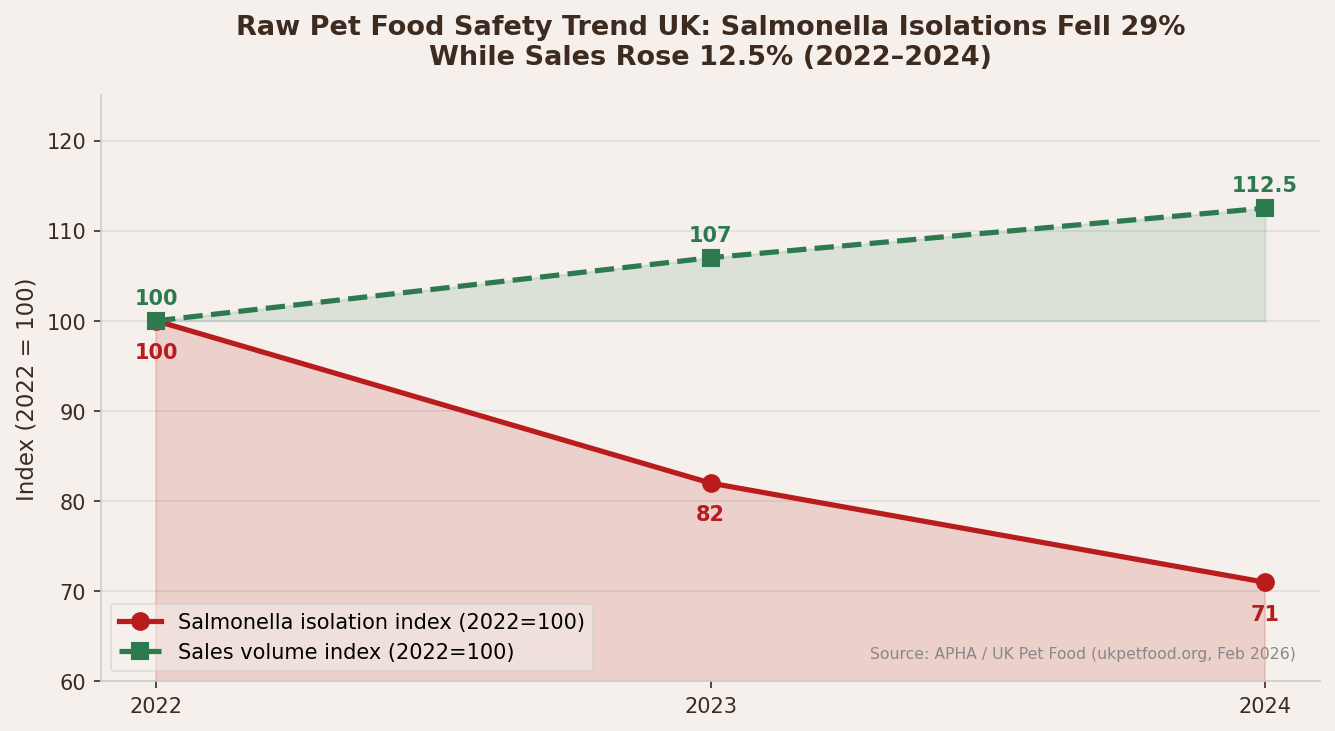
UK raw pet food manufacturing safety trend. Source: APHA / UK Pet Food (ukpetfood.org, February 2026).
Raw Dog Food Statistics UK: The Real Cost of Raw Feeding in 2026
Cost is frequently cited as the primary barrier to raw feeding adoption, and the raw dog food statistics UK cost data confirms the food cost gap is real. Commercial raw typically costs more per day than kibble. But the full cost picture — once veterinary expenses are factored in — is considerably more nuanced than the bag-vs-pouch price comparison suggests. The raw dog food statistics UK financial analysts most useful to owners go beyond food costs alone.
Food Costs: Like-for-Like Comparison
For a medium-sized dog of approximately 20kg, commercial raw feeding costs an average of £3–£5 per day, equating to £1,095–£1,825 per year. Premium kibble for the same dog runs approximately £1.30–£2 per day, or £475–£730 per year. Budget kibble can be considerably cheaper still. The raw dog food statistics UK food cost data puts raw at roughly 2–2.5 times the cost of premium kibble on food alone — a genuine financial consideration for many households.
Cost Per Day: UK Estimates by Dog Size (2026)
| Dog Size | Raw (Commercial) | Premium Kibble | Budget Kibble |
|---|---|---|---|
| Small (10kg) | £1.50–£2.50/day | £0.65–£1.00/day | £0.30–£0.50/day |
| Medium (20kg) | £3.00–£5.00/day | £1.30–£2.00/day | £0.60–£1.00/day |
| Large (35kg) | £5.00–£8.00/day | £2.00–£3.20/day | £1.00–£1.60/day |
The Veterinary Cost Equation
The food cost comparison shifts significantly once veterinary expenditure is included. According to the PDSA Animal Wellbeing Report 2024, the average UK dog owner spends £1,000–£1,500 per year on veterinary care. But the raw dog food statistics UK veterinary usage data suggests raw-fed dogs use these services far less frequently.
A UK veterinary practice study (Experiment.com) found that raw-fed dogs were more than twice as likely not to visit a vet in any given year compared to kibble-fed dogs. The causal direction requires careful interpretation — healthier dogs may be more likely to be fed raw — but the magnitude is striking. This is one of the most-referenced pieces of raw dog food statistics UK veterinary researchers have contributed to the debate.
The most dramatic real-world data point comes from Queensland Guide Dogs (Australia), which reported an 82% reduction in veterinary bills after transitioning more than 200 working dogs from kibble to a raw diet. While this is a single institutional case study rather than a controlled trial, the scale of the reduction — across a large, professionally managed cohort — is significant, and it is widely cited in raw feeding cost analyses.
For dogs with chronic allergies managed on conventional diets, the total annual cost picture becomes even more relevant. Ongoing medication, veterinary allergy shots, and specialist dermatology visits can easily total £2,000–£4,000 per year — costs that frequently exceed the raw feeding food premium by a considerable margin. The raw dog food statistics UK cost-benefit analysis changes dramatically once chronic condition management is included.
The net cost verdict:
When veterinary costs are factored in alongside food costs, the total annual expense of raw feeding versus premium kibble for a typical medium-breed dog is broadly comparable — and for dogs with chronic health conditions previously managed on conventional diets, raw feeding can represent a significant net saving — a nuance the cost literature increasingly emphasises.
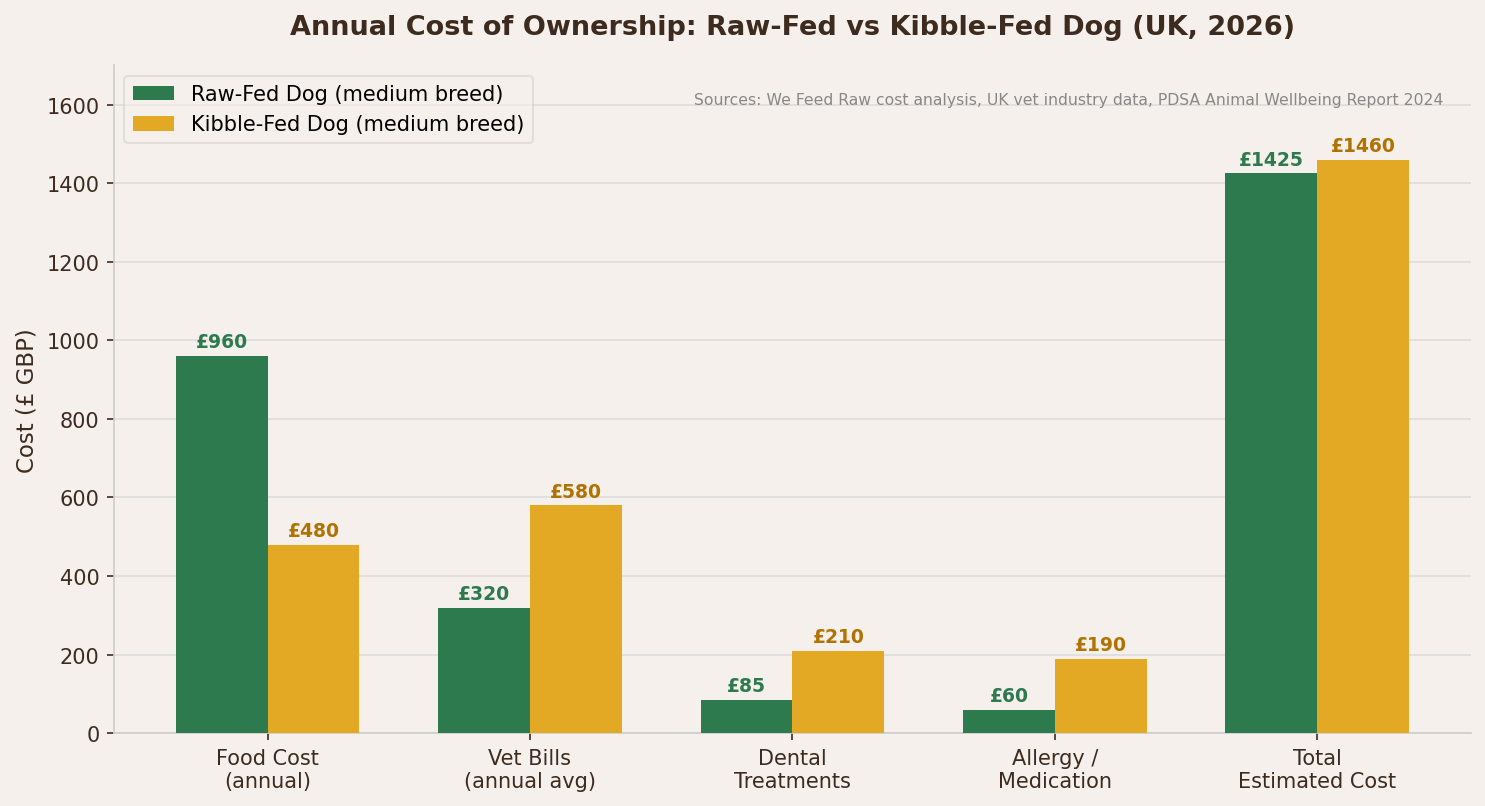
Estimated annual cost comparison for a medium-breed dog. Sources: We Feed Raw cost analysis, PDSA Animal Wellbeing Report 2024, UK vet industry data.
Raw Dog Food Statistics UK: Key Figures at a Glance
The following headline figures represent the most frequently cited raw dog food statistics UK data points across academic and industry sources in 2025–2026. These are the numbers most likely to appear in media coverage, parliamentary briefings, and veterinary guidance documents.
What the Raw Dog Food Statistics UK Data Doesn’t Say
Any responsible analysis of raw dog food statistics UK sources must acknowledge what the evidence base does not yet support — as clearly as it identifies what it does. The raw dog food statistics UK research has grown substantially in recent years, but it has real limitations that honest reporting requires noting.
- •Observational studies, not randomised controlled trials: The majority of DogRisk studies are observational in design. When reviewing raw dog food statistics UK epidemiological research, it is important to note these studies identify associations, not proven causation. A randomised controlled trial assigning dogs to raw or kibble diets from birth and following them over years remains the gold standard the field has not yet achieved.
- •Self-selection bias: Owners who choose to feed raw may be more health-conscious and attentive generally. This makes it difficult to attribute observed health differences purely to diet. The raw dog food statistics UK owner survey data cannot fully disentangle diet from owner management practices.
- •BVA position: The British Veterinary Association states clearly that “further research is needed before definitive dietary recommendations can be made.” Even the most enthusiastic reading of the raw dog food statistics UK academic literature does not yet justify a blanket recommendation for all dogs.
- •FSA safety data context: The raw dog food statistics UK food safety data from the FSA applies across the entire product range — including poorly sourced or handled products. It does not distinguish between regulated manufacturers and lower-quality sources. Product quality varies enormously.
- •The data supports further investigation — not a blanket prescription: The raw dog food statistics UK research base is compelling enough to warrant serious attention from the veterinary community. It does not yet constitute sufficient evidence for a population-wide recommendation to switch all dogs to raw feeding regardless of individual circumstances.
Ready to Start Your Dog on Raw?
Use our free raw dog food calculator to get a precise daily portion for your dog based on their weight, age and activity level — the right starting point for any raw feeding journey.
Try Our Free CalculatorFrequently Asked Questions
Is raw dog food growing in the UK?
Yes — significantly. The raw dog food statistics UK market analysts publish consistently point to strong structural growth. The UK raw pet food sector is estimated at £421 million in 2025, and raw product registrations across Europe grew 21% between 2022 and 2024 (FEDIAF). Online raw pet food sales are expanding at 5.5% CAGR (Grand View Research), faster than the overall pet food market. Corporate consolidation — including the acquisition of Natural Instinct by The Nutriment Company in July 2024 — reflects a sector in transition from niche to mainstream. The raw dog food statistics UK trend data consistently points to a category in structural growth, not a passing phase.
What does the research say about raw feeding and dog health?
The most comprehensive raw dog food statistics UK health researchers have compiled comes from the DogRisk group at the University of Helsinki. Their large-scale epidemiological studies — including one covering more than 7,000 dogs — found puppyhood raw feeding significantly associated with lower rates of skin allergies, IBD, ear infections, dental calculus, and hip dysplasia in adult dogs. A 2025 Staffordshire Bull Terrier study found that raw-fed dogs had better metabolic biomarkers compared to kibble-fed dogs. Most of these studies are observational rather than controlled trials, and the BVA recommends further research before definitive recommendations are made. The raw dog food statistics UK health evidence is encouraging but should be interpreted alongside professional veterinary advice.
Is raw dog food safe according to UK authorities?
The raw dog food statistics UK food safety agencies publish presents a nuanced picture. The Food Standards Agency’s 2023–2024 survey found 35% of raw pet food products sampled contained harmful bacteria — a figure that applies to uncooked raw meat and is comparable to contamination rates in human raw meat products. More positively, APHA data published in February 2026 shows Salmonella isolations in UK raw pet food manufacturing fell 29% between 2022 and 2024, while sales rose 12.5%. No laboratory-confirmed human infections attributable to raw pet food were identified in a global survey of 5,611 owners (Axelsson et al., 2021). UK Pet Food’s official guidance is that risk is best managed through responsible manufacturing and standard hygiene at home. The raw dog food statistics UK regulatory trend data shows a sector under increasing oversight.
Bottom Line: What the Raw Dog Food Statistics UK Data Tells Us in 2026
The raw dog food statistics UK data paints a clear and consistent picture: this is a sector that has moved well beyond niche status, is growing faster than the overall pet food market, and is operating under increasingly rigorous regulatory oversight. The raw dog food statistics UK safety profile is improving even as sales rise. The research base on health outcomes — while not yet at the level of randomised controlled trials — is substantial, large-scale, and methodologically credible. The cost comparison, once veterinary expenditure is included alongside food costs, is far closer than raw feeding critics typically acknowledge.
None of this means raw feeding is right for every dog, every owner, or every circumstance. The BVA’s call for further research is legitimate and important. Individual dogs have individual nutritional requirements, and any major dietary change should involve a conversation with a qualified veterinary professional. But the weight of the raw dog food statistics UK evidence now available in 2026 makes it increasingly difficult to dismiss raw feeding as a fringe trend without scientific backing.
The raw dog food statistics UK data supports taking raw feeding seriously — as a growing market, a legitimate nutritional approach, and a subject worthy of ongoing rigorous research. When the raw dog food statistics UK picture is read as a whole — market data, health outcomes, safety trends, and cost analysis together — the conclusion is clear: this is a sector that has earned its place in mainstream veterinary and consumer conversation. Owners, vets, and policymakers alike are best served by engaging with the raw dog food statistics UK evidence as it actually stands: nuanced, encouraging, and still evolving.
Sources & References
- Business Research Company (2026). Pet Raw Food Global Market Report.
- Grand View Research (2025). UK Pet Food Market Size and Trends.
- FEDIAF (2024). European Pet Food Industry Federation Annual Report.
- University of Helsinki DogRisk Research Group (2020–2025). Multiple nutrition-disease association studies.
- UK Pet Food / APHA (February 2026). Response to Food Standards Agency Raw Pet Food Report.
- Food Standards Agency (2024). Survey of microbiological contamination in raw dog and cat food.
- British Veterinary Association (2023). Companion Animal Feeding Working Group Report.
- PDSA (2024). Animal Wellbeing Report.
- Experiment.com (UK). Who has more health problems — raw or dry-fed dogs?
- We Feed Raw (2026). Is Raw Food Cheaper Than Vet Bills for Chronic Conditions?
- Axelsson et al. (2021). Low number of owner-reported suspected transmission of foodborne pathogens from raw meat-based diets. Global survey, 5,611 respondents.